9 citations
,
September 1977 in “Journal of Small Animal Practice” Mange in guinea pigs can be cured with gamma benzene hexachloride washes.
April 2018 in “Veterinary Pathology” Tigers had a skin condition causing hair loss and inflammation, but the cause is unknown and treatment didn't work.
 March 2025 in “Buletin Veteriner Udayana”
 The cat's mite and lice infestations were successfully treated with medication and supportive care.
29 citations
,
February 1989 in “Journal of Cutaneous Pathology” A unique hair tumor with a rippled pattern was identified, showing incomplete differentiation and unusual cell arrangements.
November 2025 in “OPAL (Open@LaTrobe) (La Trobe University)” DAB labeling effectively identifies collagen type III and PDGFR in horse skin, but may show false positives.
2 citations
,
January 2018 in “Open journal of stomatology” Tongue cancer cells show more plectin-1 than non-cancer cells, but both have similar levels of trichohyalin.
13 citations
,
January 1985 in “International Journal of Dermatology” The document found differences in lesion distribution and microscopic features among trichostasis spinulosa and similar skin conditions.
 13 citations
,
July 2012 in “Pigment Cell & Melanoma Research”
13 citations
,
July 2012 in “Pigment Cell & Melanoma Research” A mutation in the Adam10 gene causes freckle-like spots on Hairless mice.
June 2025 in “Proceedings of the National Academy of Sciences” A PIK3CA mutation in Schwann cells causes severe nerve damage and increased glycolysis, but early treatment can help.
2 citations
,
January 2022 in “Indian dermatology online journal” Dermoscopy may not show hookworms clearly, and comparing it with tissue studies could improve diagnosis accuracy for skin conditions caused by parasites.
January 2005 in “Journal of Zhejiang University(Sciences Edition)” Yuyi hairless mice lose hair after birth, develop thick, loose skin with folds, and show disorganized skin structure as they age.
44 citations
,
January 1957 in “Public Health Reports (1896-1970)” Animal ringworm is common and can spread to humans.
1 citations
,
July 2025 in “Methods and Protocols” The CAM is a useful model for studying burn wounds and testing treatments.
58 citations
,
November 1969 in “British Journal of Dermatology” Netherton's disease causes multiple hair defects.
 2 citations
,
April 2022 in “PubVet”
2 citations
,
April 2022 in “PubVet” The cat's skin condition improved significantly with medication, with no relapse.
13 citations
,
August 1999 in “Journal of Investigative Dermatology” Bikunin is found on the cell boundaries of certain skin layers and may help regulate skin and hair functions.
14 citations
,
May 2016 in “International Journal of Molecular Sciences” PP2Acα is essential for proper hair and skin development.
87 citations
,
April 1973 in “Endocrinology” The chemicals 17βC and its methyl ester can block the effects of testosterone on hamster skin but not the effects of DHT.
1 citations
,
September 2024 in “Veterinary Medicine and Science” Afoxolaner effectively treats mange in guinea pigs with one dose.
Rat hair follicle bulge cells can become nerve and glial cells, showing potential for neuroprotection.
Immunological skin diseases in pigs are rare and can be caused by immune system issues or external factors.
16 citations
,
June 1992 in “Journal of Investigative Dermatology”  10 citations
,
January 2014 in “BioMed research international”
10 citations
,
January 2014 in “BioMed research international” Rat whisker cells can help turn other cells into nerve cells and might be used to treat brain injuries or diseases.
 April 2023 in “The journal of investigative dermatology/Journal of investigative dermatology”
 The study found that a key immune pathway protecting hair follicles is reduced in a mouse model of scarring hair loss.
 December 2023 in “Research Square (Research Square)”
 12-Methoxy carnosic acid from rosemary might be a good natural treatment for hair loss.
2 citations
,
April 2024 in “Medical Journal Armed Forces India” 5 citations
,
October 2002 in “PubMed” Human hair keratin scaffolds help repair injured muscles by breaking down and activating muscle cell growth.
 22 citations
,
December 2003 in “Veterinary clinical pathology”
22 citations
,
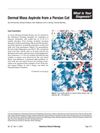
December 2003 in “Veterinary clinical pathology” The Persian cat has a skin infection caused by a fungus, treatable with antifungal medication.
43 citations
,
March 1942 in “The Journal of experimental medicine/The journal of experimental medicine” Mice need pantothenic acid to make inositol.
14 citations
,
August 2014 in “The FASEB Journal” CAP1/Prss8 does not activate PAR2 or inhibit PN-1.