June 2025 in “Materials Today Bio” A silk fibroin hydrogel boosts wound healing and hair growth by increasing collagen and hair follicles.
 August 2024 in “Life Science Alliance”
 Helminth protein helps wounds heal better by reducing scarring and promoting tissue growth.
 November 2023 in “Frontiers in veterinary science”
 The study provides insights into hair growth mechanisms in yaks.
 September 2023 in “The Journal of Dermatology”
 Transplanting one's own hair follicle cells can improve hair loss in men and women, and is particularly effective in women.
 April 2018 in “The journal of investigative dermatology/Journal of investigative dermatology”
 Double-stranded RNA helps regenerate hair follicles by increasing retinoic acid production and signaling.
 September 2016 in “Springer eBooks”
 Fat-derived stem cells may help treat skin aging and hair loss.
 June 2008 in “Regenerative Medicine”
 The book explains the science of tissue repair and regeneration, its medical uses, challenges, and ethical concerns.
December 2022 in “Nature Communications” Bead-jet printing of stem cells improves muscle and hair regeneration.
 15 citations
,
May 2004 in “Facial Plastic Surgery Clinics of North America”
15 citations
,
May 2004 in “Facial Plastic Surgery Clinics of North America” The document concludes that while "hair follicle cloning" shows promise for unlimited donor hair, it faces challenges with consistency and safety in humans.
 31 citations
,
January 2014 in “International Journal of Trichology”
31 citations
,
January 2014 in “International Journal of Trichology” The arrector pili muscle might play a role in hair loss and needs more research to understand its impact.
 22 citations
,
October 2018 in “Aesthetic Plastic Surgery”
22 citations
,
October 2018 in “Aesthetic Plastic Surgery” Understanding hair follicle biology and stem cell control could lead to new hair loss treatments.
 10 citations
,
January 2016 in “Annals of Dermatology”
10 citations
,
January 2016 in “Annals of Dermatology” 3D-cultured dermal papilla cells are better at inducing hair follicles than adipose-derived stem cells.
 1 citations
,
August 2024 in “Journal of Cutaneous and Aesthetic Surgery”
1 citations
,
August 2024 in “Journal of Cutaneous and Aesthetic Surgery” Hair density decreases with age, especially in the 60s.
 September 2025 in “Journal of Cosmetic Dermatology”
 Rb-bFGF improves hair transplant results and patient satisfaction with fewer complications.
August 2024 in “Bioorganic Chemistry” Cedrol from ginger can promote hair growth when taken orally.
 April 2021 in “Advances in Cosmetic Surgery”
 Hair restoration can be achieved through non-surgical treatments like minoxidil, antiandrogens, phototherapy, and PRP procedures, or through surgical methods like hair transplantation. Continued treatment is needed to maintain results, and full results are visible after 12-18 months.
 6 citations
,
September 1997 in “Dermatologic Surgery”
6 citations
,
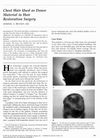
September 1997 in “Dermatologic Surgery” Chest hair can be used for scalp hair transplants when there's not enough scalp hair.
January 2006 in “中华医学杂志:英文版” Cultured skin cells can trigger hair growth and the amount of certain proteins they produce affects their ability to regenerate hair follicles.
 129 citations
,
October 2007 in “The New England Journal of Medicine”
129 citations
,
October 2007 in “The New England Journal of Medicine” Over one-third of women experience hair loss, with female-pattern hair loss being most common, and treatments include minoxidil and possibly hair transplantation.
 72 citations
,
September 1997 in “Dermatologic Surgery”
72 citations
,
September 1997 in “Dermatologic Surgery” Careful planning and patient counseling can lead to excellent hair transplant results, often in one or two sessions.
 25 citations
,
April 2008 in “Archives of Dermatological Research”
25 citations
,
April 2008 in “Archives of Dermatological Research” Encapsulated human hair cells can substitute for natural hair cells to grow hair.
 18 citations
,
July 2007 in “Hair transplant forum international”
18 citations
,
July 2007 in “Hair transplant forum international” Platelet-rich plasma may improve healing and hair growth in hair transplant surgery.
 3 citations
,
October 2007 in “Expert Review of Dermatology”
3 citations
,
October 2007 in “Expert Review of Dermatology” Hair ages due to various factors and treatments like minoxidil and finasteride can help, but more research and better public awareness are needed.
Hair transplants are effective for male and female pattern baldness, have evolved in technique, and require careful planning for natural results and managing complications.
 September 2006 in “Plastic and Reconstructive Surgery”
 Hair transplant surgeries can be improved by preserving follicles in a special solution, and surgeries done at outpatient facilities are more profitable than those at hospitals.
 August 2001 in “Dermatologic Surgery”
 The KNU implanter for hair transplants showed a high survival rate of 90%+ for transplanted hairs after 6 months, with benefits like natural hair direction and fewer scars.
 208 citations
,
December 2003 in “Journal of Investigative Dermatology”
208 citations
,
December 2003 in “Journal of Investigative Dermatology” Certain cells from hair follicles can create new hair and contribute to hair growth when implanted in mice.
STAT5 and Sox18 are crucial for hair growth and wound healing.
 218 citations
,
January 2013 in “The Lancet Oncology”
218 citations
,
January 2013 in “The Lancet Oncology” Chemotherapy causes hair loss by damaging hair follicles and stem cells, with more research needed for prevention and treatment.
 1 citations
,
September 2016 in “Journal of Dermatological Science”
1 citations
,
September 2016 in “Journal of Dermatological Science” FGF18 treatment during hair's resting phase can protect against hair loss from radiation.