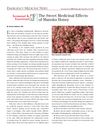
 September 2012 in “Emergency medicine news”
 Manuka honey is effective for treating wounds and burns.
 July 2012 in “Springer eBooks”
 The document concludes that proper diagnosis and treatment of nonscarring alopecias can improve quality of life and hair regrowth is possible as the hair follicle remains intact.
 January 2012 in “Methods in pharmacology and toxicology”
 TRPV3 could be a target for treating pain, skin disorders, and hair problems, but more research is needed to create effective drugs.
 October 2010 in “Reproductive Biomedicine Online”
 Women with pituitary adenomas often have reproductive issues, like irregular periods and trouble getting pregnant, but not always breast milk production without pregnancy.
 February 2010 in “ePrints Soton (University of Southampton)”
 Male sexual differentiation is regulated independently, while female differentiation occurs in an androgenic environment, affecting conditions like congenital adrenal hyperplasia.
 January 2008 in “Springer eBooks”
 Thyroid disease can cause hair loss and treating thyroid problems might help with hair disorders.
 January 1991 in “Journal of Pediatric Health Care”
 Hair loss in children can be caused by fungal infections, trauma, autoimmune disorders, or stress, and treatments vary depending on the cause.
 January 2019 in “Springer eBooks”
 PRP and LLLT can improve hair growth in AGA, but more research needed.
November 2024 in “Biophysical Chemistry” Hair structure changes immediately during perm treatment, with initial damage partially restored later.
Modern shampoos use a mix of surfactants and other ingredients to clean, reduce irritation, and improve performance.
 2 citations
,
January 2014 in “Sen i Gakkaishi”
2 citations
,
January 2014 in “Sen i Gakkaishi” The new hair straightening method keeps hair straight permanently by using specific creams and heat.
10 citations
,
August 2021 in “Cosmetics” The best shampoo formula used 1% high-weight hyaluronic acid, 10% acidic sophorolipid, and 1% salt for effective hair conditioning and cleansing without sulfates or silicones.
 12 citations
,
October 1954 in “Textile Research Journal”
12 citations
,
October 1954 in “Textile Research Journal” Hair absorbs alkali bromide salts and water, affecting its structure, with absorption decreasing at higher temperatures.
 2 citations
,
January 2015 in “Sen'i Gakkaishi”
2 citations
,
January 2015 in “Sen'i Gakkaishi” Washing permed hair after using thioglycolic acid helps reform strong bonds, making hair stronger.
3 citations
,
September 2024 in “Animal Cells and Systems” Sargassum horneri extract speeds up burn healing and reduces inflammation.
 17 citations
,
July 2019 in “Scientific reports”
17 citations
,
July 2019 in “Scientific reports” Surface and internal treatments can help prevent hair lipid loss during washing.
 April 2026 in “Zenodo (CERN European Organization for Nuclear Research)”
 Cationic conditioning systems improve hair combability and sensory feel.
 April 2026 in “Zenodo (CERN European Organization for Nuclear Research)”
 Cationic conditioning systems improve hair combability and sensory feel.
1 citations
,
January 2017 in “Indian Journal of Dermatology Venereology and Leprology” Hard water increases magnesium deposits on hair without changing its structure.
 4 citations
,
January 2021 in “Skin appendage disorders”
4 citations
,
January 2021 in “Skin appendage disorders” Washing hair daily is better and preferred, with no negative effects.
 June 2026 in “Frontiers in Marine Science”
 Codium sp. seaweed fractions can enhance skincare and be used for biochar, promoting sustainability.
 18 citations
,
December 2021 in “Foods”
18 citations
,
December 2021 in “Foods” Seaweeds contain beneficial compounds with potential uses in food, cosmetics, and health, but more research is needed to improve extraction and safety.
May 2009 in “International Journal of Cosmetic Science” Permanent waving damages hair protein and weakens hair, especially with repeated treatments using sodium thioglycolate.
November 2004 in “Qucosa (Saxon State and University Library Dresden)” Active agents mainly stay on the hair surface after short washes.
1 citations
,
January 2022 in “Book Publisher International (a part of SCIENCEDOMAIN International)” Hydrogen peroxide is the main risk factor for melanoma in swimmers, not UV light.
 18 citations
,
January 2015 in “Data series”
18 citations
,
January 2015 in “Data series” Hurricane Sandy increased contamination in estuarine sediments in New Jersey and New York.
 1 citations
,
April 2021 in “Han'gug miyong haghoeji/Journal of the Korean society of cosmetology”
1 citations
,
April 2021 in “Han'gug miyong haghoeji/Journal of the Korean society of cosmetology” Aspartic acid at 0.75% makes perms more effective and less damaging to hair.
 7 citations
,
January 2007 in “Elsevier eBooks”
7 citations
,
January 2007 in “Elsevier eBooks” Shampoos clean hair mainly with surfactants and have added ingredients for extra benefits.
3 citations
,
August 2008 in “PubMed” Repeated digital perming with sodium thioglycolate lotion significantly damages hair protein and structure.
March 2013 in “International Journal of Nuclear Energy Science and Engineering” Natural compounds like essential oils and melatonin can improve pet health and address issues like stress and hair problems.