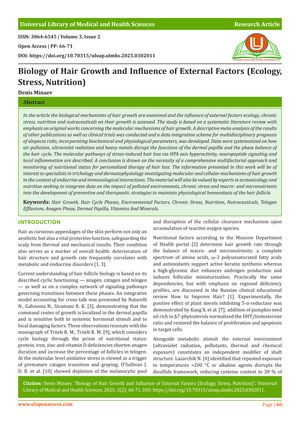
The article reviews the biological mechanisms of hair growth and assesses the impact of external factors such as ecology, chronic stress, and nutrition. It highlights how air pollution, UV radiation, and heavy metals can disrupt hair cycle phases and dermal papilla functions. Stress-induced hair loss is linked to HPA axis hyperactivity, neuropeptide signaling, and local inflammation. The study emphasizes the need for a comprehensive, multifactorial approach and nutritional monitoring for personalized hair loss therapy. This research is valuable for specialists in trichology, dermatophysiology, ecotoxicology, and nutrition, aiming to develop strategies to maintain hair follicle homeostasis.

104 citations
,
January 2023 in “Journal of Clinical Medicine” A holistic approach is needed to effectively address hair loss by understanding and influencing the hair growth cycle.
6 citations
,
January 2020
10 citations
,
April 2015 in “PubMed” Rosemary oil and minoxidil 2% both effectively increase hair count in people with androgenetic alopecia, but rosemary oil causes less scalp itching.
July 2024 in “The journal of investigative dermatology/Journal of investigative dermatology” A new wearable device stops hair loss and boosts hair growth safely.
GFC injections significantly improved hair growth and quality with minimal side effects.
Baldness is often hereditary and linked to male hormones, becoming noticeable when half the hair is lost.
Some treatments like minoxidil, finasteride, and surgery can help with hereditary hair loss.
August 2015 in “Europe PMC (PubMed Central)” Using body measurements can help achieve good results in plastic surgery like reshaping the torso, but it doesn't work for all body types.
Some cancer treatments cause different types of hair loss, but scalp cooling can help prevent it.
370 citations
,
September 1999 in “The New England Journal of Medicine” Finasteride and minoxidil are effective for hair loss, but continued research is needed for better treatments.