22 citations
,
June 2020 in “iScience” Sox21 is crucial for tooth development and enamel formation by preventing cells from changing into a different type.
May 2026 in “Frontiers in Medicine” The patient's hair improved after treatment, but the genetic link is unclear.
 184 citations
,
September 2006 in “PLoS Genetics”
184 citations
,
September 2006 in “PLoS Genetics” The Apc gene is crucial for normal skin and thymus development.
January 2014 in “生命科学(ISSN1934-7391)” A certain gene variation can affect protein production and is linked to male pattern baldness.
A specific gene change in APCDD1 increases the risk of hair loss.
 5 citations
,
January 2021 in “iScience”
5 citations
,
January 2021 in “iScience” Using a combination of specific cell cycle regulators is better for safely keeping hair root cells alive indefinitely compared to cancer-related methods.
 32 citations
,
August 2019 in “Nature Communications”
32 citations
,
August 2019 in “Nature Communications” Chemotherapy causes permanent hair follicle damage by triggering stem cell loss.
 18 citations
,
July 2014 in “Molecular Medicine Reports”
18 citations
,
July 2014 in “Molecular Medicine Reports” UVB radiation changes the levels of certain microRNAs in skin cells, which may affect cell survival and hair growth.
 9 citations
,
August 2024 in “Tissue Engineering and Regenerative Medicine”
9 citations
,
August 2024 in “Tissue Engineering and Regenerative Medicine” Collagen-heparin-FGF2-VEGF scaffolds can improve skin healing.
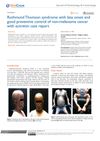 August 2024 in “Journal of Dermatology & Cosmetology”
 Acitretin effectively prevented skin cancer in a patient with late-onset Rothmund-Thomson syndrome.
 February 2010 in “ePrints Soton (University of Southampton)”
 Male sexual differentiation is regulated independently, while female differentiation occurs in an androgenic environment, affecting conditions like congenital adrenal hyperplasia.
 199 citations
,
April 2010 in “Nature”
199 citations
,
April 2010 in “Nature” A gene called APCDD1, which controls hair growth, is found to be faulty in a type of hair loss called hereditary hypotrichosis simplex.
26 citations
,
September 2009 in “Clinical genetics” Arab APS1 patients have unique and recurrent AIRE gene mutations.
 April 2026 in “Human Genome Variation”
 The MBTPS2 gene variant c.970+5G>A is a common mutation causing IFAP syndrome.
March 2024 in “Preprints.org” Activated protein C helps protect mice from radiation damage.
 92 citations
,
January 2012 in “International Journal of Biological Sciences”
92 citations
,
January 2012 in “International Journal of Biological Sciences” The document introduced a new naming system for keratin-associated proteins to improve clarity and communication across species.
 April 2023 in “Cancer research”
 KRTAP2-3 could help predict cancer recurrence by identifying specific cancer cells.
1 citations
,
April 2024 in “Metabolites” Activated protein C helps protect mice from long-term radiation damage.
2 citations
,
October 2000 in “Journal of Investigative Dermatology” AUC and APL are distinct conditions needing careful clinical assessment.
April 2024 in “Demiroglu Science University Florence Nightingale Journal of Medicine” Understanding the APCDD1 gene can lead to new hair loss treatments.
70 citations
,
August 2006 in “Cancer Research” AP-1 controls tumor cell type by affecting key signaling pathways.
 6 citations
,
January 2011 in “Journal of pediatric endocrinology & metabolism/Journal of pediatric endocrinology and metabolism”
6 citations
,
January 2011 in “Journal of pediatric endocrinology & metabolism/Journal of pediatric endocrinology and metabolism” An 11-year-old Greek girl was diagnosed with a rare genetic disorder, highlighting the importance of genetic testing and family history.
24 citations
,
February 2011 in “The American journal of pathology” AIRE protein, defective in APECED patients, is found in skin and hair cells and interacts with cytokeratin 17.
17 citations
,
January 2010 in “PubMed” CD10 helps distinguish between basal cell carcinoma and benign hair follicle tumors.
11 citations
,
February 2011 in “The Journal of Dermatology” Mutations in the hairless gene cause a rare form of permanent hair loss.
69 citations
,
May 2002 in “Journal of Investigative Dermatology” Congenital atrichia with papular lesions is often misdiagnosed, and new diagnostic criteria can improve accuracy.
20 citations
,
January 2002 in “Laboratory Animals” Mutations in the hairless gene cause hair loss and skin cysts in rhesus macaques.
8 citations
,
January 2011 in “International journal of trichology” Accurate diagnosis of APL is crucial to avoid unnecessary treatments.
September 2019 in “Journal of Investigative Dermatology” CCCA in women of African ancestry may be caused by PADI3 gene mutations and intense hair grooming.
5 citations
,
February 2008 in “Histopathology”