 64 citations
,
August 2007 in “Artificial Organs”
64 citations
,
August 2007 in “Artificial Organs” PHBV nanofiber matrices help wounds heal faster when used with hair follicle cells.
October 2024 in “Applied Sciences” Cell growth improved the strength of 3D bioprinted structures.
 10 citations
,
January 2024 in “Polymer Chemistry”
10 citations
,
January 2024 in “Polymer Chemistry” Lipid–polymer hybrid nanoparticles can improve genome editing delivery and outcomes.
 January 2007 in “Universiti Putra Malaysia Institutional Repository (Universiti Putra Malaysia)”
 Keratin-gelatin film improves wound healing in dogs and cats.
 7 citations
,
May 2016 in “European Polymer Journal”
7 citations
,
May 2016 in “European Polymer Journal” The new nanocarriers improve how well water-insoluble drugs dissolve and allow for controlled drug release.
March 2026 in “ACS Omega” The hydrogel significantly speeds up wound healing and improves skin recovery.
The method effectively creates uniform, viable cell spheroids for 3D cell culture.
 November 2025 in “Communications Materials”
 Pomelo peel can be turned into materials that help stop bleeding and heal wounds better than commercial dressings.
37 citations
,
August 2020 in “Cosmetics” Biodegradable masks are needed to reduce pollution and meet eco-friendly demands.
1 citations
,
January 2023 in “Chemical Engineering Journal” 3 citations
,
May 2012 in “Journal of Biological Macromolecules” Keratin film can effectively mimic human hair for testing hair damage.
1 citations
,
August 1999 in “ACS symposium series” Polymer JR400 sticks to hair but washes off with detergent.
January 2026 in “SSRN Electronic Journal” 
The research found that nanoparticles coated with chitosan improved the skin penetration of the drug finasteride.
7 citations
,
November 2025 in “Pharmaceutics” Polymer- and lipid-based nanostructures can improve wound healing by controlling contamination, supporting cell growth, and aiding tissue repair.
September 2025 in “Acta Biomaterialia” A new tissue adhesive helps wounds heal better by allowing more cells to enter.
 88 citations
,
December 2018 in “Advanced Healthcare Materials”
88 citations
,
December 2018 in “Advanced Healthcare Materials” Layer-by-Layer self-assembly is promising for biomedical uses like tissue engineering and cell therapy, but challenges remain in material safety and process optimization.
September 2021 in “Crop research/Crop Research” Aluminum foil packaging kept the biotin nutrition bar with the least bacteria after 30 days.
11 citations
,
February 2020 in “Journal of Biomaterials Science Polymer Edition” The new GelMet hydrogel can effectively support skin cell growth for tissue engineering.
 1 citations
,
September 2023 in “International Journal of Biological Macromolecules”
1 citations
,
September 2023 in “International Journal of Biological Macromolecules” The hydrogel made from plant polysaccharide and gelatin helps wounds heal faster by absorbing fluids and maintaining a moist healing environment.
Keratin-gelatin film improves wound healing in pets better than bFGF-gelatin.
4 citations
,
January 2020 in “Elsevier eBooks” Natural polymers can protect, repair, and promote hair regrowth.
4 citations
,
March 2023 in “Cancer Innovation” Flexible bioelectronics show promise in non-invasive cancer detection and treatment but need improvements in stability and effectiveness.
 October 2025 in “Advanced Healthcare Materials”
 The hydrogels improve wound healing and tissue regeneration better than traditional treatments.
19 citations
,
January 2015 in “International Journal of Cosmetic Science” The improved nanoparticles can effectively target hair follicles for drug delivery.
28 citations
,
September 2023 in “International Journal of Biological Macromolecules” The new dressing speeds up wound healing better than current options.
 2 citations
,
January 2008 in “Journal of Society of Cosmetic Chemists of Japan”
2 citations
,
January 2008 in “Journal of Society of Cosmetic Chemists of Japan” PMS nanoparticles improve damaged hair by protecting and restoring its surface and color.
18 citations
,
February 2025 in “Macromolecular Rapid Communications” Thermo-responsive polymers in nanoparticles enable targeted drug delivery and advanced therapies by releasing drugs at specific temperatures.
7 citations
,
January 2024 in “Regenerative Biomaterials” The new dressing improves chronic wound healing by preserving and releasing growth factors effectively.
 1 citations
,
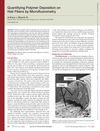
July 2019 in “Microscopy Today”
1 citations
,
July 2019 in “Microscopy Today” Microfluorometry effectively measures how much polymer coats and penetrates hair, useful for evaluating hair products.