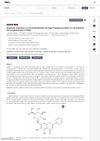
Enzymatic synthesis improved the water solubility of the flavonoid baicalin, which may help treat hair loss conditions.
 January 2019 in “Journal of Pharmacognosy and Phytochemistry”
 The methanolic fruit extract of Citrullus colocynthis contains bioactive compounds that may support its use in traditional medicine and drug development.
 May 2017 in “bioRxiv (Cold Spring Harbor Laboratory)”
 The peach gene pCTG134 helps control the interaction between auxin and ethylene hormones during fruit ripening.
10 citations
,
January 2016 in “ACG Case Reports Journal” Long-term Cape Aloe use causes harmless colon pigmentation that can help detect polyps.
 36 citations
,
January 2018 in “Scientific reports”
36 citations
,
January 2018 in “Scientific reports” Eating glucoraphanin can help prevent psychosis in offspring whose mothers had immune system activation.
 47 citations
,
March 2018 in “Journal of Pharmaceutical and Biomedical Analysis”
47 citations
,
March 2018 in “Journal of Pharmaceutical and Biomedical Analysis” Researchers identified new compounds in Platycladi Cacumen and found variations in its flavonoid content, which could aid in its quality control.
8 citations
,
February 2025 in “Cell Systems” Engineered bacteria can deliver antioxidants to protect skin.
July 2026 in “Macromolecular Bioscience” Sulfated glycosaminoglycans from Acipenser baerii cartilage improve wound healing and fibroblast function.
4 citations
,
April 1989 in “The Journal of Dermatology” Trichohyalin granules help inner root sheath cells in hair follicles harden by integrating with keratin filaments.
 December 2016 in “Springer eBooks”
 Chrousos Syndrome is caused by mutations that make the body less sensitive to glucocorticoids, leading to various symptoms and requiring high-dose treatment.
5 citations
,
January 2015 in “Molecular Genetics and Metabolism” 19 citations
,
November 2022 in “Antioxidants” Ginger peel polysaccharides modified with zinc effectively reduce inflammation.
 3 citations
,
January 2009 in “Sen'i Gakkaishi”
3 citations
,
January 2009 in “Sen'i Gakkaishi” Using both TGA and DTDG in hair straightening reduces hair damage compared to using TGA alone.
13 citations
,
September 2012 in “Cell & tissue research/Cell and tissue research” pCLCA2 protein may help maintain skin structure and function.
6 citations
,
November 1977 in “International Journal of Legal Medicine” Human hair contains a substance that shows blood group A activity.
July 1999 in “Proceedings of SPIE, the International Society for Optical Engineering/Proceedings of SPIE” Hair analysis can reveal glucose levels in diabetic patients.
 8 citations
,
January 2016 in “Journal of fiber science and technology”
8 citations
,
January 2016 in “Journal of fiber science and technology” Bleaching hair increases cysteic acid levels in a predictable way.
 April 2025 in “Dermatology Practical & Conceptual”
 Increased LC3 gene expression may be linked to premature graying of hair.

Sinapic acid and glabridin together help hair growth in androgenetic alopecia.
 61 citations
,
November 2004 in “Annals of the Academy of Medicine Singapore”
61 citations
,
November 2004 in “Annals of the Academy of Medicine Singapore” Hair follicle stem cells are mainly in the bulge region and can help repair skin and form hair and glands, but more research is needed to fully understand them.
 1 citations
,
February 2025 in “Scientific Reports”
1 citations
,
February 2025 in “Scientific Reports” CD4 is crucial for maintaining skin stem cell balance and aiding wound healing.
 1 citations
,
January 2018 in “Elsevier eBooks”
1 citations
,
January 2018 in “Elsevier eBooks” The skin's dermal layer contains true stem cells with diverse functions and interactions that need more research to fully understand.
September 2022 in “The Korean Tea Society” Houttuynia cordata compounds may help with anti-aging and hair loss.
4 citations
,
September 2025 in “International Journal of Molecular Sciences” EGCG in green tea benefits skin, hair, cancer treatment, weight loss, diabetes, heart, and brain health.
 10 citations
,
June 2014 in “Journal of Pharmacy and Pharmacology”
10 citations
,
June 2014 in “Journal of Pharmacy and Pharmacology” Germacrone in Curcuma aeruginosa extract degrades at high temperatures but is stable in certain solutions and unaffected by pH levels.
 July 2023 in “bioRxiv (Cold Spring Harbor Laboratory)”
 Chitosan slows root hair growth and causes a buildup of callose at low concentrations, but at high concentrations, it only inhibits growth without callose buildup.
8 citations
,
January 2024 in “Current Research in Food Science” Combining polysaccharides with alginate improves protection and release of pumpkin seed protein in digestion.
 4 citations
,
January 1994 in “Yakugaku zasshi”
4 citations
,
January 1994 in “Yakugaku zasshi” EPC-K is stable except at very acidic pH or when exposed to sunlight, and it can decompose in low ethanol concentrations.
9 citations
,
October 2017 in “Frontiers in plant science” The peach gene CTG134 helps control the interaction between auxin and ethylene, which could lead to new agricultural chemicals.
January 2013 in “วารสารเภสัชศาสตร์อีสาน (Isan Journal of Pharmaceutical Sciences, IJPS)” Mangosteen peel extract effectively inhibits acne-causing bacteria.