 June 2024 in “Indian Dermatology Online Journal”
 Topical tofacitinib is effective and safe for treating alopecia areata.
 June 2024 in “The Open dermatology journal”
 The herbal extract is as effective and safe as 3% minoxidil for treating hair loss.
 February 2024 in “International Journal of Dermatology”
 The document concludes that more local research on African skin and hair is needed despite increased scientific output from Sub-Saharan Africa.
 April 2023 in “Australasian Journal of Dermatology”
 Lentiginous melanoma is most common on the face, especially the nose, cheek, and pre-auricular areas, with men more likely to have it on the scalp, ears, upper back, and trapezius, and women on the cheek and anterior arm. Sun damage is a key factor in its formation.
January 2022 in “Clinical Cases in Dermatology” Early treatment of traction alopecia can reverse hair loss; prevention involves avoiding tight hairstyles.
Stem cell treatments show promise for hair loss but need more research.
March 2023 in “Clinical, Cosmetic and Investigational Dermatology” Spironolactone can effectively treat hair loss with manageable side effects.
November 2021 in “Arquivos Médicos dos Hospitais e da Faculdade de Ciências Médicas da Santa Casa de São Paulo” Microneedling with minoxidil, platelet-rich plasma, and mesotherapy improves hair growth significantly.
 1 citations
,
January 2021 in “Our Dermatology Online”
1 citations
,
January 2021 in “Our Dermatology Online” A scalp infection can look like alopecia areata and get worse if treated incorrectly.
12 citations
,
September 2022 in “Frontiers in Genetics” Enhancing CD8+ T cell function to induce ferroptosis in tumor cells may help treat skin melanoma.
 10 citations
,
August 1991 in “PubMed”
10 citations
,
August 1991 in “PubMed” Inflammation, possibly triggered by a specific bacteria and activated by UV radiation, may contribute to male pattern baldness.
April 2025 in “Australasian Journal of Dermatology” Daughters with affected mothers may develop frontal fibrosing alopecia early.
 January 2021 in “Our Dermatology Online”
 A young man's hair loss was the only sign of syphilis, which improved after treatment.
30 citations
,
October 2013 in “BMC dermatology” VEGF gel increases hair growth but may have potential toxicity.
26 citations
,
April 2023 in “Medicina” Platelet-rich plasma therapy improves oral lichen planus symptoms with few side effects.
 23 citations
,
September 2019 in “Dermatology practical & conceptual”
23 citations
,
September 2019 in “Dermatology practical & conceptual” The study concluded that AAI and DAA are forms of the same disease, with different symptoms in men and women, and that corticosteroid treatment is effective.
6 citations
,
November 2020 in “Chinese Medical Journal” Combining minoxidil and fibroblast growth factor is more effective for treating male hair loss than using either alone.
 4 citations
,
February 2022 in “JEADV Clinical Practice”
4 citations
,
February 2022 in “JEADV Clinical Practice” COVID-19 can cause various skin issues in children, mostly not severe, with chilblain-like lesions being common, especially in adolescents.
 4 citations
,
January 2022 in “The journal of investigative dermatology/Journal of investigative dermatology”
4 citations
,
January 2022 in “The journal of investigative dermatology/Journal of investigative dermatology” A faulty KLHL24 gene leads to hair loss by damaging hair follicle stem cells.
4 citations
,
September 2021 in “Sensors” LED therapy can safely and effectively regrow eyebrows in people with frontal fibrosing alopecia.
2 citations
,
July 2025 in “Frontiers in Veterinary Science” MicroRNAs and AI can improve cashmere goat hair quality and aid in hair disorder diagnosis.
2 citations
,
November 2024 in “Aesthetic Surgery Journal” Vibration anesthesia effectively and safely reduces pain during botulinum toxin injections.
2 citations
,
July 2021 in “Genes” A specific genetic change in the KRT71 gene causes a hair loss condition in Hereford cattle.
2 citations
,
February 2021 in “Case reports in dermatological medicine” The new topical botanical formulation significantly regrew hair in all five patients without side effects.
1 citations
,
December 2023 in “International journal of molecular sciences” miR-199a-3p controls hair growth and is linked to alopecia areata.
 June 2026 in “Frontiers in Medicine”
 Hair-loss trials have increased, but need more diverse participants and standardized measures.
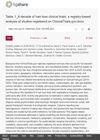
More hair-loss studies are needed with standardized outcomes and diverse participants.
 June 2026 in “Archives of Dermatological Research”
 PCAT1 and HOTAIR levels are lower in people with androgenic alopecia.
 February 2026 in “Dove Medical Press (Taylor and Francis Group)”
 Upadacitinib can effectively regrow hair in alopecia areata patients without worsening sarcoidosis.
January 2026 in “Clinics and Practice” Baricitinib helps alopecia areata and may improve psoriasis, but its effect on psoriatic arthritis is unclear.