1 citations
,
July 2024 in “Journal of lasers in medical sciences” The laser treatment effectively improved facial pigmentation with no major side effects.
 January 2025 in “Surgical & Cosmetic Dermatology”
 Erbium-YAG laser treatment improved folliculitis decalvans without causing hair loss.
April 2023 in “Journal of The American Academy of Dermatology” Use a 3-mm spot size and specific protective eyewear for safer and more effective laser treatment of facial veins.
 May 2019 in “Pakistan Journal of Pharmaceutical Sciences”
 CO2 laser treatment may be more effective for skin rejuvenation.
 13 citations
,
October 2019 in “Journal of lasers in medical sciences”
13 citations
,
October 2019 in “Journal of lasers in medical sciences” CO2 laser treatment for aging skin significantly changes immune system-related genes.
 2 citations
,
January 2022 in “Skin appendage disorders”
2 citations
,
January 2022 in “Skin appendage disorders” A combination of methotrexate injections and CO2 laser treatment led to complete hair regrowth in two patients with hard-to-treat alopecia.
 January 2025 in “Lasers in Medical Science”
 Combining fractional CO2 laser with topical dutasteride is more effective for treating male hair loss than using the laser alone.
 2 citations
,
March 2019 in “Lasers in surgery and medicine”
2 citations
,
March 2019 in “Lasers in surgery and medicine” Higher light doses cause more damage to hair follicles, predicting better hair removal results.
 26 citations
,
May 2017 in “Lasers in Medical Science”
26 citations
,
May 2017 in “Lasers in Medical Science” Laser therapy and hair growth factors significantly improve hair density in male baldness.
 20 citations
,
December 2003 in “Journal of Cosmetic and Laser Therapy”
20 citations
,
December 2003 in “Journal of Cosmetic and Laser Therapy” An 800nm diode laser safely and effectively reduces hair for about 8 months, with most patients satisfied and few side effects.
11 citations
,
January 2022 in “Journal of Healthcare Engineering” The combined treatment is more effective and safer for improving sunken acne scars.
 May 2013 in “Proceedings of SPIE”
 Researchers created a system that accurately aligns laser beams automatically.

The 1540nm fractional erbium-glass laser helps treat hair loss caused by hormones.
June 2026 in “Dermatologic Clinics”  27 citations
,
August 2014 in “Journal of Cosmetic and Laser Therapy”
27 citations
,
August 2014 in “Journal of Cosmetic and Laser Therapy” Different lasers and radiofrequency affect skin differently, important for dermatologists to choose the right treatment.
 35 citations
,
July 2009 in “Optics express”
35 citations
,
July 2009 in “Optics express” Researchers created a new light source that improves chemical imaging by removing background noise.
4 citations
,
June 2025 in “Journal of Cosmetic Dermatology” The triple-wavelength diode laser effectively and safely reduces hair and improves skin appearance in people with darker skin.
Laser diode light boosts hair follicle cell growth and certain gene expressions.
 April 2019 in “Archives of aesthetic plastic surgery”
 Higher fluences in 808-nm diode laser treatments are more effective for axillary hair removal.
September 2023 in “Journal of the American Academy of Dermatology” December 2025 in “Lasers in Surgery and Medicine”  July 2025 in “The Egyptian Journal of Hospital Medicine”
 Preparing scars with PRP or CO₂ laser improves hair transplant success.
 February 2009 in “Journal of The American Academy of Dermatology”
 Fractional infrared technology is effective and safe for treating cervical laxity.
 March 1997 in “The American Journal of Cosmetic Surgery”
 A new hair transplant method showed promising results and a study found how deep a CO₂ laser can penetrate skin.
 May 2023 in “Current Applied Science and Technology”
 Higher power CO2 laser causes more severe skin burns and damage.
January 2025 in “Dermatologic Therapy” Combining fractional CO2 laser with type III collagen improves acne scar treatment.
 3 citations
,
March 2008 in “Medical laser application”
3 citations
,
March 2008 in “Medical laser application” Lasers have become safer and more effective for treating skin problems and hair removal.
 January 2021 in “Dermatologic Therapy”
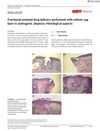
 Channels stay open for 24 hours, making laser treatment potentially effective for hair loss.
 17 citations
,
January 2021 in “Dermatology and Therapy”
17 citations
,
January 2021 in “Dermatology and Therapy” Laser-assisted drug delivery has shown improved treatment outcomes for skin conditions and has potential to reduce side effects and treatment time.
1 citations
,
January 2016 in “Journal of Advanced Plastic Surgery Research” The laser treatment effectively reduced hair growth in women with hirsutism, with temporary side effects.