 December 2022 in “Scientific Reports”
 Stem cells from whiskers can be transplanted to stimulate hair growth.
 14 citations
,
September 2018 in “Asian-Australasian Journal of Animal Sciences”
14 citations
,
September 2018 in “Asian-Australasian Journal of Animal Sciences” Rex rabbits' hair follicles develop dynamically in the first 8 weeks, with key genes and proteins changing over time.
 32 citations
,
June 2013 in “Journal of Investigative Dermatology”
32 citations
,
June 2013 in “Journal of Investigative Dermatology” Mice without certain skin proteins had abnormal skin and hair development.
 52 citations
,
October 2004 in “Veterinary dermatology”
52 citations
,
October 2004 in “Veterinary dermatology” Melatonin and mitotane treatment led to hair re-growth in 62% of dogs with Alopecia X, but this was not always linked to normal hormone levels.
2 citations
,
September 1978 in “Anatomia Histologia Embryologia” Alkaline phosphatase activity in Beagle dog hair follicles is weakest in anagen and strongest in telogen.
 5 citations
,
October 2013 in “Veterinary Clinics of North America: Equine Practice”
5 citations
,
October 2013 in “Veterinary Clinics of North America: Equine Practice” Some horses lose hair without inflammation or itching due to various conditions, and while mainly a cosmetic issue, diagnosis requires examination and biopsies, and breeding is not advised if it's hereditary.
1 citations
,
June 2022 in “Tidsskrift for Den norske legeforening” A young boy's uncombable hair is due to a rare genetic condition that usually improves over time.
 10 citations
,
September 2013 in “Veterinary dermatology”
10 citations
,
September 2013 in “Veterinary dermatology” Medroxyprogesterone injections caused hair regrowth in some dogs with alopecia X.
 16 citations
,
April 2012 in “Journal of mammalogy”
16 citations
,
April 2012 in “Journal of mammalogy” Young female Australian fur seals are losing hair due to low tyrosine and zinc levels and high pollution exposure.
Tan sheep's unique fur traits are determined during the embryonic stage by specific genes.
1 citations
,
December 2018 in “Veterinary dermatology” The hair coat disorder in Schipperkes is similar to Alopecia X and involves increased androstenedione levels and hair cycle arrest.

Canine fetal hair follicle stem cells show pluripotency, with higher S100 protein expression at 40 days.
5 citations
,
August 2002 in “Veterinary Dermatology” Combining terbinafine and mitotane effectively treated a schnauzer's skin infection and hormone disorder.
January 2009 in “Electronic Theses of LMU Munich (Ludwig-Maximilians-Universität München)” Haarpower® did not significantly reduce excessive shedding in dogs.
 1 citations
,
April 2023 in “bioRxiv (Cold Spring Harbor Laboratory)”
1 citations
,
April 2023 in “bioRxiv (Cold Spring Harbor Laboratory)” Climate-related nutritional stress may cause hair loss in juvenile male Guadalupe fur seals.
 January 2007 in “Acta Veterinaria Brno”
 Trilostane treatment successfully restored hair growth in a dog with alopecia X.
 February 2024 in “Buletin Veteriner Udayana”
 The dog with severe hair loss and itching improved after treatment for ehrlichiosis and demodicosis.
February 2026 in “Revista Saber Digital” Deslorelin effectively treats alopecia X in dogs.
27 citations
,
January 2000 in “Developmental Dynamics” Mutations in the Whn gene affect hair keratin gene expression differently.
13 citations
,
September 1997 in “Archives of Dermatology” The boy likely has a fungal infection causing hair loss.
The document concludes that the girl's hairlessness is likely inherited from her parents.
March 2026 in “Buletin Veteriner Udayana” Stella fully recovered from Malassezia dermatitis after 4 weeks of treatment.
5 citations
,
January 2005 in “PubMed” Apoptosis is important in the hair cycle of dogs.
22 citations
,
April 1967 in “Australian Journal of Zoology” Southern elephant seals develop hair follicles and skin layers before birth, with moulting starting a week after birth and finishing in three weeks.
54 citations
,
October 2007 in “The FASEB Journal” Phospholipase C-δ1 is crucial for normal hair development.
September 2015 in “Advances in small animal medicine and surgery” Deslorelin can help regrow hair in most intact male dogs with alopecia.
23 citations
,
December 1991 in “Annals of the New York Academy of Sciences” Balding scalps slow down hair growth.
 March 2026 in “Mammalogy Notes”
 Sterilize stray dogs to prevent disease spread to wildlife.
 August 2018 in “Pediatric Dermatology”
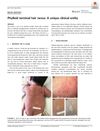
 A baby had a unique skin condition with a pale patch and surrounding dark hairs, not linked to other health issues.
January 2016 in “Lithuanian University of Health Sciences” Different diseases cause specific skin and hair follicle changes in dogs with alopecia.