
Neeli Bhringadi hair oil improves hair growth and reduces graying.
 June 2026 in “International Journal of Drug Delivery Technology”
 The herbal hair oil is safe and may promote hair growth.
 May 2026 in “The EMBO Journal”
 Skin aging can be slowed by targeting cells, hormones, and the microbiome.
 May 2026 in “International Journal of Versatile Research and Analysis”
 The herbal hair serum with hibiscus and amla effectively improves hair health and reduces dandruff.
 April 2026 in “International Journal of Drug Delivery Technology”
 Nanoparticle-based dressings and theranostic innovations improve chronic wound care by effectively targeting biofilms and offering precise treatment.
 April 2026 in “International Journal of Allied Medical Sciences and Clinical Research”
 The polyherbal hair serum is a safe and effective alternative for reducing dandruff and strengthening hair.
 April 2026 in “Dermatology and Therapy”
 Experts agree on understanding hair aging to improve diagnosis and treatments.
 March 2026 in “Trends in Sciences”
 PRF and CGF are becoming more popular than PRP in regenerative medicine due to their simplicity and lack of additives.
 March 2026 in “Buletin Veteriner Udayana”
 The dog's skin condition and worm infection improved with a combination of candlenut oil and other treatments.
 January 2026 in “International Journal of Advanced Research in Science Communication and Technology”
 The herbal beard balm effectively nourishes and hydrates beards, reducing dryness and irritation.
 January 2026 in “Biomaterials Science”
 The formulation helps improve wound healing and skin repair.
 December 2025 in “Brazilian Journal of Hair Health”
 The Spiral Model helps understand hair growth changes with age and identify hair problems early.
 November 2025 in “Quality in Sport”
 Collagen supplements improve skin, hair, and nails, especially with vitamin C and minerals.
 November 2025 in “Communications Materials”
 Pomelo peel can be turned into materials that help stop bleeding and heal wounds better than commercial dressings.
 October 2025 in “Indian Journal of Plastic Surgery”
 Stem cells show promise in anti-aging and reconstructive surgery, but more research is needed.
 September 2025 in “Cureus”
 GLP-1 agonists may help treat certain skin conditions.
 June 2025 in “World Journal of Medical Oncology”
 Bio-based materials like hydrogels show promise in treating skin cancer with fewer side effects, but more research is needed.
 January 2025 in “International Journal of Pharmacognosy and Clinical Research”
 The herbal scalp serum may help hair growth by reducing DHT levels.
 December 2024 in “Biomedical & Pharmacology Journal”
 Hair Tonic A, with white tea extract, is better for improving hair health.
 August 2024 in “International Journal of Basic & Clinical Pharmacology”
 Secretome-based therapies could improve hair growth better than current treatments.
 January 2024 in “International Research Journal of Modernization in Engineering Technology and Science”
 The herbal shampoo effectively cleans and conditions hair while being non-toxic and reducing allergic reactions.
 November 2023 in “Anticancer Research”
 Using ultrasound may make cisplatin more effective against cervical cancer in mice.
 October 2023 in “Animal production science”
 Vitamin A deficiency changes cattle hair structure, while pregnancy may improve it, suggesting hair can indicate cattle health.
 July 2023 in “bioRxiv (Cold Spring Harbor Laboratory)”
 Chitosan slows root hair growth and causes a buildup of callose at low concentrations, but at high concentrations, it only inhibits growth without callose buildup.
 June 2021 in “Journal of Emerging Technologies and Innovative Research”
 Rice water and hibiscus can help improve hair health and growth.
 January 2019 in “Springer eBooks”
 Acne can appear or persist in adulthood due to hormonal changes, external factors, or substance use, and requires appropriate treatment.
 January 2016 in “Springer eBooks”
 Understanding drug interactions, side effects, and patient-specific factors is crucial for effective dermatological care.
 January 2014 in “Durham e-Theses (Durham University)”
 Notch1 helps skin heal by attracting cells that aid repair.
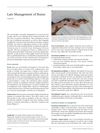 June 2002 in “Surgery (oxford)”
 The document says that treating burns late focuses on improving function, appearance, and helping patients return to normal life, using both non-surgical and surgical methods.

Dermal stem cells help regenerate hair follicles and heal skin wounds.