8 citations
,
June 2020 in “The journal of investigative dermatology/Journal of investigative dermatology” A boy's skin fragility and sparse hair were caused by a genetic mutation affecting skin cell adhesion.
8 citations
,
March 2023 in “British Journal of Dermatology” Next-generation sequencing greatly improves understanding and treatment of genetic hair disorders.
33 citations
,
December 1982 in “Developmental Medicine & Child Neurology” Hair-shaft abnormalities can indicate neurological disorders, some of which are treatable.
January 1996 in “Studia iuridica” Two new gene mutations cause a rare hair disorder.
10 citations
,
November 2018 in “The Italian Journal of Pediatrics/Italian journal of pediatrics” Early diagnosis of Trichorhinophalangeal syndrome type 1 is crucial for treatment and was achieved through clinical examination and family history.
 14 citations
,
April 2011 in “Journal of the American Academy of Dermatology”
14 citations
,
April 2011 in “Journal of the American Academy of Dermatology” Researchers found a gene mutation responsible for a rare hair loss condition.
 7 citations
,
May 2010 in “Journal of Cutaneous Pathology”
7 citations
,
May 2010 in “Journal of Cutaneous Pathology” A new genetic area linked to a rare hair loss condition was found on chromosome 13 in a Chinese family.
April 2024 in “Anais Brasileiros de Dermatologia”  4 citations
,
January 2018 in “International Journal of Trichology”
4 citations
,
January 2018 in “International Journal of Trichology” A rare genetic disease causes sparse hair and early blindness due to a gene mutation.
2 citations
,
May 2024 in “International Journal of Dermatology” 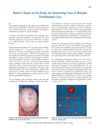 5 citations
,
January 2014 in “Journal of Cutaneous and Aesthetic Surgery”
5 citations
,
January 2014 in “Journal of Cutaneous and Aesthetic Surgery” A woman had 13 non-cancerous cysts on her scalp successfully removed in one surgery.
 4 citations
,
January 2014 in “International Journal of Trichology”
4 citations
,
January 2014 in “International Journal of Trichology” A 12-year-old boy with a rare genetic condition has progressive hair loss with no effective treatment.
 July 2014 in “Journal of the Portuguese Society of Dermatology and Venereology”
 Trichoscopy is useful for diagnosing and monitoring hair and scalp conditions.
54 citations
,
November 1986 in “Journal of the American Academy of Dermatology” Generalized trichoepitheliomas with hair loss may indicate myasthenia gravis.
1 citations
,
March 2023 in “Journal of the Turkish Academy of Dermatology” Temporal triangular alopecia may be linked to sebaceous nevus and shows a new pinkish background feature.
Hair dysplasias involve various hair disorders causing fragility, breakage, and poor hair adhesion.
November 2021 in “Skin appendage disorders” Self-induced hair loss should be considered in patients with androgenetic alopecia.
35 citations
,
September 2011 in “The Journal of Dermatology” Trichoscopy helps accurately diagnose temporal triangular alopecia.
62 citations
,
October 1999 in “Journal of Investigative Dermatology” New mutations in hair keratin genes can change hair structure and cause monilethrix, with nail issues more common in certain gene mutations.
 May 2017 in “InTech eBooks”
 Trichoscopy and trichogram are useful for diagnosing hair and scalp conditions.
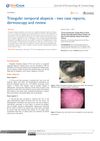 2 citations
,
February 2018 in “Journal of dermatology & cosmetology”
2 citations
,
February 2018 in “Journal of dermatology & cosmetology” Triangular temporal alopecia is a benign hair loss pattern best diagnosed with dermoscopy, with limited treatment options like surgery and hair transplantation.
January 2019 in “Revista Dermatológica Centro Uraga” Alopecia triangular temporal is a rare condition with unclear causes and treatment, but trichoscopy helps in diagnosis.
 June 2023 in “British Journal of Dermatology”
 The protein called small nuclear ribonucleoprotein polypeptide E is identified as a cause of a type of hair loss without other symptoms.
 September 2025 in “Egyptian Journal of Dermatology and Venerology”
 Dermoscopy is crucial for diagnosing rare scalp tumors like trichofolliculoma.
June 2001 in “European Journal of Dermatology” A 54-year-old woman experienced progressive hair loss starting in adolescence, leading to sparse scalp hair and almost no eyebrows or eyelashes.
 January 2025 in “Clinical Dermatology Review”
 Trichoscopy helps accurately diagnose Netherton syndrome, often mistaken for atopic dermatitis.
 5 citations
,
January 2012 in “International journal of trichology”
5 citations
,
January 2012 in “International journal of trichology” A 2-year-old boy had no hair and unusual organ placement, and it's unclear if it's genetic or coincidental.
13 citations
,
February 2012 in “International Journal of Dermatology” A new genetic mutation in the CDH3 gene causes hair loss and eye problems in young people.
 August 2023 in “Acta Scientific Paediatrics”
 A baby from an Indian family had a rare genetic disorder causing no scalp or body hair due to a specific gene deletion.
October 2025 in “Indian Journal of Paediatric Dermatology” Trichoscopy is a helpful tool for diagnosing Netherton syndrome.