6 citations
,
June 2025 in “Nano Biomedicine and Engineering” Smart nano-PROTACs improve cancer treatment by targeting proteins more precisely and reducing side effects.
January 2026 in “PubMed Central” Natural product nanoparticles improve drug absorption but need better stability and production methods.
 46 citations
,
January 2020 in “Research”
46 citations
,
January 2020 in “Research” Microneedle technology has advanced for painless drug delivery and sensitive detection but faces a gap between experimental use and clinical needs.
2 citations
,
June 2025 in “Nano Research” Gold nanoclusters can improve detection, imaging, and therapy in medicine.
 51 citations
,
January 2024 in “Nanoscale”
51 citations
,
January 2024 in “Nanoscale” Nano-PROTACs could improve drug targeting and delivery by using nanotechnology.
The research found how certain drugs and polymers form stable complexes, which could help develop new pharmaceutical forms.
April 2026 in “SSRN Electronic Journal” 10 citations
,
November 2018 in “bioRxiv (Cold Spring Harbor Laboratory)” New laser particles can track thousands of cells in 3D models, improving single-cell analysis.
30 citations
,
November 2024 in “ACS Materials Au” Microneedles are promising for disease monitoring and drug delivery due to their minimal invasiveness and versatility.
 January 2024 in “LA Referencia (Red Federada de Repositorios Institucionales de Publicaciones Científicas)”
 Carbon Quantum Dots can effectively detect cobalt ions and methylcobalamin in water.
 September 2025 in “Medical Materials Research”
 Microneedles offer a painless, precise, and versatile method for drug delivery and disease treatment.
10 citations
,
December 2023 in “International Journal of Nanomedicine” Cell membrane-coated nanoparticles could improve gene therapy by enhancing delivery and targeting of nucleic acids.
The research shows how certain drugs can form stable structures with polymers, which is important for making new pharmaceuticals.
 2 citations
,
December 2021
2 citations
,
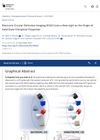
December 2021 The research found that the properties of solid-state Electronic Circular Dichroism (ss-ECD) are influenced by the orientation of local crystals, which could help in examining and mapping chiral materials like pharmaceutical ingredients.
January 2025 in “SSRN Electronic Journal” 12 citations
,
June 2020 in “Crystals” A new method successfully created tiny zinc oxide particles in silica for potential use in drug delivery and other applications.
The research shows how certain drug molecules form stable structures with polymers, which could help create new drug forms.
 January 2025 in “Journal of Pharmaceutical Research Science & Technology”
 Dissolving microneedles offer efficient, minimally invasive drug delivery through the skin.
June 2026 in “Advanced Science” New cryomicroneedles can improve hair growth and regeneration.
7 citations
,
December 2024 in “International Journal of Pharmaceutics” Dissolving microneedle patches can effectively deliver drugs over time.
 42 citations
,
January 2021 in “Journal of Clinical Medicine”
42 citations
,
January 2021 in “Journal of Clinical Medicine” Microneedle arrays with nanotechnology show promise for painless drug delivery through the skin but need more research on safety and effectiveness.
124 citations
,
January 2009 Understanding and controlling crystallization is crucial for producing high-quality organic compounds in industry.
 December 2025 in “Journal of Pharma Insights and Research.”
 Injectable cryogels can deliver drugs and aid tissue repair with minimal surgery.
September 2023 in “bioRxiv (Cold Spring Harbor Laboratory)” Microneedle patches with different pore sizes can effectively deliver drugs and trigger strong immune responses.
 7 citations
,
August 2022 in “Journal of Nanobiotechnology”
7 citations
,
August 2022 in “Journal of Nanobiotechnology” Advancements in nanoformulations for CRISPR-Cas9 genome editing can respond to specific triggers for controlled gene editing, showing promise in treating incurable diseases, but challenges like precision and system design complexity still need to be addressed.
4 citations
,
November 2024 in “Materials” The film creates vibrant colors and can be used in food sensors and cosmetics.
September 2024 in “Medical Sains Jurnal Ilmiah Kefarmasian” Nanostructured lipid carriers improve anti-aging drug delivery and effectiveness in cosmetics.
 223 citations
,
October 2020 in “Microsystems & Nanoengineering”
223 citations
,
October 2020 in “Microsystems & Nanoengineering” Microtechnology methods improve organoid production for medical research.
57 citations
,
December 2012 in “Journal of Biomedical Optics” Confocal microscopy is useful for studying how nanoparticles interact with skin.
23 citations
,
November 2021 in “Frontiers in Chemistry” Nanozymes could improve disease treatment and detection.