 1 citations
,
July 2024 in “Skin Research and Technology”
1 citations
,
July 2024 in “Skin Research and Technology” Patients with androgenetic alopecia have thinner subcutaneous fat layers in their frontal scalp compared to healthy individuals.
April 2016 in “ValpoScholar (Valparaiso University)” Finasteride side effects may be reduced by considering brain differences.
 2 citations
,
February 2018 in “Journal of dermatology & cosmetology”
2 citations
,
February 2018 in “Journal of dermatology & cosmetology” Triangular temporal alopecia is a benign hair loss pattern best diagnosed with dermoscopy, with limited treatment options like surgery and hair transplantation.
July 2025 in “International Journal of Trichology” Trichoscopy effectively diagnoses temporal triangular alopecia in children.
7 citations
,
January 2013 in “International Journal of Oral and Maxillofacial Surgery” Accurate diagnosis and various treatments can rejuvenate the upper face for a natural look.
 2 citations
,
July 2005 in “Journal of The American Academy of Dermatology” January 2008 in “The Internet Journal of Plastic Surgery”
2 citations
,
July 2005 in “Journal of The American Academy of Dermatology” January 2008 in “The Internet Journal of Plastic Surgery” Thorough cleaning and hair removal are essential to effectively treat and prevent recurrent pilonidal sinus.
 1 citations
,
November 2023 in “Contact dermatitis”
1 citations
,
November 2023 in “Contact dermatitis” Some people with Frontal Fibrosing Alopecia may be allergic to a common sunscreen ingredient.
June 2026 in “Journal of Cosmetic Dermatology” FFA patients have higher metal levels in hair, possibly linked to product use.
 1 citations
,
April 2018 in “SLEEP”
1 citations
,
April 2018 in “SLEEP” People with obstructive sleep apnea are more likely to get herpes zoster, but nightmares don't affect the risk.
 1 citations
,
June 2021 in “Computer methods and programs in biomedicine”
1 citations
,
June 2021 in “Computer methods and programs in biomedicine” Children with cancer had slightly more unusual facial shapes than healthy kids, but not enough to easily tell them apart.
January 2023 in “Dermatologic Therapy” Intralesional corticosteroids and 5-alpha-reductase inhibitors are the best treatments for frontal fibrosing alopecia.
November 2017 in “DOAJ (DOAJ: Directory of Open Access Journals)” Certain medications and smaller pupil size increase the risk of intraoperative floppy iris syndrome during eye surgery.
 13 citations
,
June 2016 in “Journal of neurological surgery”
13 citations
,
June 2016 in “Journal of neurological surgery” Using L-PRF membranes for skull base surgery might help healing, but more research is needed.
March 2026 in “Anais Brasileiros de Dermatologia” Lichen planopilaris and frontal fibrosing alopecia are likely distinct diseases with different tissue involvement.
55 citations
,
July 2016 in “Eye”  December 2020 in “TURKDERM”
 A 3-year-old boy was diagnosed with a rare, non-scarring hair loss condition called temporal triangular alopecia.
 March 2026 in “Dermatology Online Journal”
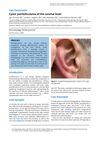
 Cystic panfolliculoma is a rare, harmless tumor that can be confused with other skin tumors.
27 citations
,
May 2016 in “British journal of dermatology/British journal of dermatology, Supplement”  187 citations
,
June 1999 in “Journal of The American Academy of Dermatology”
187 citations
,
June 1999 in “Journal of The American Academy of Dermatology” Finasteride effectively treats frontal hair loss with few side effects.
February 2022 in “Brazilian Journal of Health Review” Most cases were lichen planus pigmentosus, highlighting the need for accurate diagnosis for proper treatment.
 January 2015 in “Hair transplant forum international”
 The document's conclusion cannot be provided because the content is not available.
 December 2023 in “The Sri Lanka Journal of Dermatology”
 A 12-year-old girl's hair loss was linked to a rare genetic condition called ALX4-related frontonasal dysplasia.
 May 2026 in “Scholars Journal of Medical Case Reports”
 Intralesional betamethasone and oral hydroxychloroquine improved hair loss in a woman with frontal fibrosing alopecia.
 December 2015 in “Actas Dermo-Sifiliográficas”
 Hair transplantation for Frontal Fibrosing Alopecia may work if the disease is inactive for 2 years and with ongoing treatment to maintain results.

Early NAS level changes affect alcohol consumption vulnerability.
1 citations
,
August 2018 in “Journal of the American Academy of Dermatology” A young woman developed facial bumps before hair loss, which is unusual for her condition.
 January 2020 in “Przegla̧d dermatologiczny”
 A 5-year-old boy was diagnosed with congenital triangular alopecia, a type of hair loss without skin changes, usually starting between ages 2-5, with no specific treatment.
8 citations
,
August 2023 in “Lasers in Surgery and Medicine” Concurrent laser and isotretinoin treatment improves acne scars more than delayed treatment.
 9 citations
,
June 2014 in “Journal of Craniofacial Surgery”
9 citations
,
June 2014 in “Journal of Craniofacial Surgery” The method for sideburn reconstruction was safe and effective, giving natural-looking hair with minimal scarring.