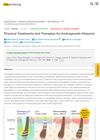
Low-level laser therapy is the most effective for hair loss, but other treatments also show promise.
November 2024 in “Dermatology and Therapy” Dermatologists should carefully choose treatments for FFA to avoid worsening the condition.
 33 citations
,
September 2016 in “Lasers in Surgery and Medicine”
33 citations
,
September 2016 in “Lasers in Surgery and Medicine” Fractional resurfacing is safe and effective for certain skin conditions in Asian patients, but care must be taken to avoid skin pigmentation issues.
81 citations
,
January 2003 in “Journal of cosmetic and laser therapy” New techniques have improved acne scar treatment, but multiple tailored sessions are often needed.
August 2024 in “Journal of Clinical Medicine” Low-level laser therapy is the most supported treatment for hair loss, but other methods show promise.
July 2025 in “Carolina Digital Repository (University of North Carolina at Chapel Hill)” Low-level laser therapy is the most supported non-drug treatment for hair loss, but combining it with other methods may be promising.
 19 citations
,
September 2015 in “Therapeutic Delivery”
19 citations
,
September 2015 in “Therapeutic Delivery” Active transdermal technologies in cosmetics help deliver skin treatments effectively, but their safety and effectiveness depend on skin type and treatment choice.
 16 citations
,
July 2007 in “Facial Plastic Surgery Clinics of North America”
16 citations
,
July 2007 in “Facial Plastic Surgery Clinics of North America” The document suggests using fat grafting and laser therapy to improve the aging Asian face and hair restoration techniques tailored to Asian hair characteristics, emphasizing natural results and cultural sensitivity.
 1 citations
,
October 2017 in “Dermatologic Clinics”
1 citations
,
October 2017 in “Dermatologic Clinics” Men are increasingly using energy-based skin treatments for workplace success, with lasers and other devices effectively improving skin and body appearance.
 1 citations
,
January 2015 in “Journal of Pigmentary Disorders”
1 citations
,
January 2015 in “Journal of Pigmentary Disorders” Treating melasma in men is difficult, especially for the deeper skin layers, and may need more than just topical treatments.
 26 citations
,
May 2015 in “Lasers in Surgery and Medicine”
26 citations
,
May 2015 in “Lasers in Surgery and Medicine” Laser treatment helped regrow hair in mice by activating a key growth pathway.
 January 2024 in “RSC pharmaceutics”
 Removing the outer skin layer increases drug absorption and offers non-invasive treatment options, with some methods allowing for quick skin recovery.

Laser treatments effectively increase hair growth in hair loss conditions.
16 citations
,
December 2022 in “Expert Opinion on Drug Delivery” AFL is safe and effective for topical drug delivery but needs larger studies and cheaper devices for wider use.
9 citations
,
January 2023 in “Indian Dermatology Online Journal” Medical aesthetics now helps treat medical conditions, expanding options for dermatologists.
 48 citations
,
January 2014 in “Dermatology Online Journal”
48 citations
,
January 2014 in “Dermatology Online Journal” New treatments for Dissecting cellulitis show promise, but more research is needed to understand the disease and establish a standard treatment plan.
 3 citations
,
March 2008 in “Medical laser application”
3 citations
,
March 2008 in “Medical laser application” Lasers have become safer and more effective for treating skin problems and hair removal.
 1 citations
,
April 2018 in “Lasers in Surgery and Medicine”
1 citations
,
April 2018 in “Lasers in Surgery and Medicine” New treatments and technologies in laser medicine show promise for improving skin conditions, fat reduction, cancer treatment, wound healing, and hair restoration.
6 citations
,
October 2023 in “Skin Research and Technology” Endolift laser treatment significantly tightens eyelids and raises eyebrows.
 8 citations
,
July 2008 in “Facial Plastic Surgery Clinics of North America”
8 citations
,
July 2008 in “Facial Plastic Surgery Clinics of North America” More men are getting non-surgical cosmetic treatments due to increased income and social acceptance, with less invasive options being preferred.
1 citations
,
November 2024 in “Journal of Cosmetic Dermatology” It's generally safe to have most skin procedures after isotretinoin, but avoid aggressive treatments and use a lower dose.
May 2025 in “Lasers in Surgery and Medicine” Nonablative monopolar radiofrequency is a safe and effective long-term treatment for acne.
 2 citations
,
January 2005 in “Journal of Cosmetic and Laser Therapy”
2 citations
,
January 2005 in “Journal of Cosmetic and Laser Therapy” New cosmetic treatments for acne, hair loss, cellulite, wrinkles, and skin resurfacing are effective.
 January 2019 in “Acta dermatovenerologica Alpina, Pannonica et Adriatica (Tiskana izd.)”
 Non-ablative radio frequency can potentially increase hair count in men with androgenetic alopecia, but some may be bothered by the smell during treatment.
 February 2021 in “Dermatological reviews”
 Nonablative radiofrequency therapy improves hair density, thickness, and growth rate.
 42 citations
,
December 2014 in “Clinical, cosmetic and investigational dermatology”
42 citations
,
December 2014 in “Clinical, cosmetic and investigational dermatology” Nonablative radiofrequency treatments, especially microneedle and fractional types, can improve acne scars by 25%–75% after 3-4 sessions, with full results in 3 months and some side effects.
 October 2025 in “Iraqi postgraduate medical journal”
 Combining laser treatment with steroid cream is more effective for alopecia areata than using the cream alone.
 24 citations
,
November 2021 in “PLoS ONE”
24 citations
,
November 2021 in “PLoS ONE” Ablative fractional laser treatment rejuvenates skin by altering gene expression and promoting wound healing and tissue regeneration.
 April 2026 in “International Journal of Clinical Case Reports and Reviews”
 A new non-invasive laser system improves chronic disease management and metabolic health.
198 citations
,
September 2007 in “Clinics in Dermatology” Radiofrequency devices effectively tighten skin without surgery.