 25 citations
,
August 2017 in “Lasers in Medical Science”
25 citations
,
August 2017 in “Lasers in Medical Science” Fractional lasers seem effective and safe for treating hair loss, but more research is needed to find the best treatment methods.
 18 citations
,
August 2018 in “Facial Plastic Surgery Clinics of North America”
18 citations
,
August 2018 in “Facial Plastic Surgery Clinics of North America” Lasers, microneedling, and PRP improve skin rejuvenation and repair, with PRP enhancing the effects when combined with other treatments.
 15 citations
,
February 2008 in “Annals of plastic surgery”
15 citations
,
February 2008 in “Annals of plastic surgery” Most patients were satisfied with diode laser hair removal and experienced no long-term side effects.
 14 citations
,
March 2012 in “Lasers in Surgery and Medicine”
14 citations
,
March 2012 in “Lasers in Surgery and Medicine” A low-power, fast laser safely reduces hair with minimal pain and few side effects.
 9 citations
,
March 2005 in “Aesthetic surgery journal”
9 citations
,
March 2005 in “Aesthetic surgery journal” The long-pulse alexandrite laser effectively removes hair permanently.
 8 citations
,
April 2024 in “Cureus”
8 citations
,
April 2024 in “Cureus” CO2 lasers are better for severe acne scars, while Er:YAG lasers are gentler with fewer side effects.
 4 citations
,
April 1999 in “Dermatologic Clinics”
4 citations
,
April 1999 in “Dermatologic Clinics” Long-pulsed ruby lasers effectively reduce hair for up to 2 years with minimal pain.
 1 citations
,
November 2023 in “Clinical, cosmetic and investigational dermatology”
1 citations
,
November 2023 in “Clinical, cosmetic and investigational dermatology” The long-pulse alexandrite laser is good for removing hair and treating skin problems like spots and veins.
 June 2026 in “Lasers in Medical Science”
 Diode laser is more effective but more painful than intense pulsed light for hair removal.

The treatment showed limited success in repigmenting hair for vitiligo-associated leukotrichia.
 May 2019 in “Pakistan Journal of Pharmaceutical Sciences”
 CO2 laser treatment may be more effective for skin rejuvenation.
 April 2019 in “Archives of aesthetic plastic surgery”
 Higher fluences in 808-nm diode laser treatments are more effective for axillary hair removal.
 October 2025 in “Animal Bioscience”
 Key genes linked to important traits in Chinese sheep and goats have been identified, but challenges remain in breeding improvements.
 206 citations
,
September 2010 in “PLoS ONE”
206 citations
,
September 2010 in “PLoS ONE” The PIRL laser cuts tissue with less damage and scarring than traditional methods.
 32 citations
,
January 2010 in “Dermatology”
32 citations
,
January 2010 in “Dermatology” Combining laser hair removal with topical eflornithine is recommended for better results in treating unwanted facial hair.
 31 citations
,
April 1999 in “Dermatologic Clinics”
31 citations
,
April 1999 in “Dermatologic Clinics” Nd:YAG laser can reduce hair with multiple treatments, but permanent removal isn't guaranteed.
 24 citations
,
March 2015 in “Dermatologic Surgery”
24 citations
,
March 2015 in “Dermatologic Surgery” Home-use cosmetic laser and light devices show modest results for hair removal and acne treatment, but more research is needed for confirmation.
 21 citations
,
December 2016 in “European journal of pharmaceutics and biopharmaceutics”
21 citations
,
December 2016 in “European journal of pharmaceutics and biopharmaceutics” Nano-sized lipid particles increase dexamethasone's skin penetration and create a reservoir in the skin layers.
 20 citations
,
April 1999 in “British journal of plastic surgery”
20 citations
,
April 1999 in “British journal of plastic surgery” Ruby laser hair removal significantly reduces hair density.
 15 citations
,
January 2003 in “Lasers in Surgery and Medicine”
15 citations
,
January 2003 in “Lasers in Surgery and Medicine” Cold air and a chilled sapphire window both protect the skin during laser treatments, and work better with water or gel, especially for darker skin.
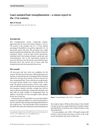 11 citations
,
June 2005 in “Journal of Cosmetic Dermatology”
11 citations
,
June 2005 in “Journal of Cosmetic Dermatology” Lasers in hair transplantation show promise but are not yet standard, with current methods causing some side effects and needles still being preferred for creating recipient sites.
 4 citations
,
January 2002 in “Journal of Cosmetic Dermatology”
4 citations
,
January 2002 in “Journal of Cosmetic Dermatology” Long-pulsed ruby laser effectively reduces hair in male-to-female transsexuals.
 2 citations
,
March 2019 in “Lasers in surgery and medicine”
2 citations
,
March 2019 in “Lasers in surgery and medicine” Higher light doses cause more damage to hair follicles, predicting better hair removal results.
 July 2026 in “Journal of the Pakistan Medical Association”
 Adding topical eflornithine improves laser hair removal results.
 March 2026 in “Research Square”
 Polymer dot nanozymes and exosomes, with laser stimulation, speed up wound healing.
 February 2026 in “International Journal of Basic & Clinical Pharmacology”
 Cosmetovigilance and clinical pharmacists can enhance safety in cosmetic treatments, especially for those with diabetes.
 January 2018 in “Springer eBooks”
 Lasers are less favored for hair transplant surgery but show promise for hair growth in controlled trials.
 February 2009 in “Journal of The American Academy of Dermatology”
 Fractional infrared technology is effective and safe for treating cervical laxity.
 February 2009 in “Journal of The American Academy of Dermatology”
 Pulsed dye laser treatment was effective for a skin condition resistant to other treatments.
 December 2020 in “Lasers in Surgery and Medicine”
 Laser safely and effectively removes unwanted scalp micropigmentation.