 January 2016 in “Journal of The American Academy of Dermatology”
 The woman has a type of scarring hair loss with red bumps around hair follicles.
8 citations
,
January 2014 in “Indian Dermatology Online Journal” Trichostasis spinulosa is a common but often unnoticed skin condition involving bundled vellus hairs, especially in people with darker skin or UV exposure.
144 citations
,
December 2017 in “Pigment cell & melanoma research” Melasma is now considered a skin aging disorder caused by sun exposure in people with a genetic tendency, which impacts treatment and prevention approaches.
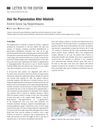 April 2025 in “Turkish Journal of Hematology”
 Nilotinib may cause gray hair to return to its original color.
 4 citations
,
January 2014 in “Indian dermatology online journal”
4 citations
,
January 2014 in “Indian dermatology online journal” Monilethrix is a genetic hair disorder causing fragile, beaded hair with no effective treatment.
August 2022 in “F1000Research” Digital gangrene can be a rare first sign of late-onset systemic lupus erythematosus.
January 2022 in “Clinical Cases in Dermatology” A woman has a permanent hair loss condition treated with steroids and new medicines, but hair might not regrow.
 13 citations
,
September 2017 in “Oncotarget”
13 citations
,
September 2017 in “Oncotarget” A certain signaling pathway in mice, when increased, causes hair to gray by depleting the cells that give hair its color.
 90 citations
,
July 2008 in “Dermatologic therapy”
90 citations
,
July 2008 in “Dermatologic therapy” Lichen planopilaris is a chronic, scarring hair loss condition with no definitive cure, requiring accurate diagnosis and treatment to manage symptoms.
July 2024 in “Journal of Investigative Dermatology” Bioengineered skin models aging well, useful for studying aging and testing treatments.
3 citations
,
August 2024 in “Skin Research and Technology” LC-OCT can help identify lupus-related scarring hair loss by spotting unique features.
 September 2022 in “The American journal of dermatopathology/American journal of dermatopathology”
 A patient with a thick scalp and hair loss was correctly diagnosed with alopecia areata and a thick scalp fat layer, not lipedematous alopecia, and regrew hair after treatment.
 January 2022 in “bioRxiv (Cold Spring Harbor Laboratory)”
 Skin lesions in Carney complex are likely caused by a specific group of skin cells that promote pigment production due to a genetic mutation.
 3 citations
,
August 2010 in “Anais brasileiros de dermatologia/Anais Brasileiros de Dermatologia”
3 citations
,
August 2010 in “Anais brasileiros de dermatologia/Anais Brasileiros de Dermatologia” A rare genetic disease caused severe, worsening hair loss from early childhood with poor treatment results.
 March 2025 in “Aging Cell”
 Reducing IGF-1 can help rejuvenate hair follicles and prevent hair graying and loss.
 2 citations
,
December 2017 in “Skin appendage disorders”
2 citations
,
December 2017 in “Skin appendage disorders” An elderly man's non-healing scalp lesion was successfully treated with a strong topical steroid.
1 citations
,
January 2018 in “Jornal Brasileiro de Patologia e Medicina Laboratorial” Monilethrix causes brittle hair and hair loss, and it runs in families.
2 citations
,
November 2023 in “Skin Research and Technology” RCM and dermoscopy help identify different types of hair loss in children.
December 2024 in “JAAD International” 4 citations
,
January 2020 in “Indian dermatology online journal” Lichen simplex chronicus on the scalp can be diagnosed by specific hair and skin signs and treated with corticosteroids and therapy.
12 citations
,
January 2000 in “Journal of cutaneous medicine and surgery” Microorganism overgrowth and hyperkeratosis may trigger immune reactions causing lichen planopilaris.
 May 2019 in “Australasian Journal of Dermatology”
 New insights in skin conditions show a complex link between certain moles and melanoma, improved hair loss treatments, and the need to identify different types of lupus.
 6 citations
,
November 2011 in “Journal of Dermatological Science”
6 citations
,
November 2011 in “Journal of Dermatological Science” A new gene mutation may allow some piebaldism patients to regain skin color in white patches.
 July 2022 in “The journal of investigative dermatology/Journal of investigative dermatology”
 A patient with a PLEC mutation has epidermolysis bullosa, muscular dystrophy, and myasthenia gravis, which improved with steroid treatment.
June 2023 in “British Journal of Dermatology” Facial lichen planopilaris may be triggered by shaving and mustard oil, and early detection is crucial for better treatment outcomes.
June 2018 in “Chinese Journal of Dermatology” Connective tissue nevi have distinct features, and reflectance confocal microscopy is useful for early diagnosis.
Pseudopelade is likely an independent disease due to its distinct features.
September 2022 in “Scientific Reports” Scalp melanoma is more common and easier to diagnose early in people with androgenetic alopecia due to sun damage.
 4 citations
,
March 2017 in “Journal of evolution of medical and dental sciences”
4 citations
,
March 2017 in “Journal of evolution of medical and dental sciences” Older adults often have dry skin and itching, with high blood pressure frequently linked to skin problems.
1 citations
,
January 2025 in “Dermatology Practical & Conceptual” Trichoscopy helps distinguish Lichen Planopilaris from Frontal Fibrosing Alopecia by identifying unique hair loss patterns.