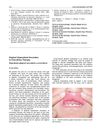
 January 2010 in “Actas Dermo-Sifiliográficas”
 A woman developed thick gums from everolimus treatment after a kidney transplant.
 July 2004 in “British Journal of Dermatology”
 The document concludes that accurate diagnosis and treatment are crucial in dermatology, and it presents various findings on skin conditions and treatments.
March 2025 in “Journal of Investigative Dermatology” The program increased awareness of traction alopecia but didn't significantly change hairstyling habits.
 January 2018 in “bioRxiv (Cold Spring Harbor Laboratory)”
 Researchers found key regions in the mouse hairless gene that control its activity in skin and brain cells, affecting hair follicle function.
 12 citations
,
January 2021 in “Journal of Investigative Dermatology”
12 citations
,
January 2021 in “Journal of Investigative Dermatology” Hair follicle studies suggest that maintaining telomere length could help treat hair loss and graying, but it's uncertain if mouse results apply to humans.
25 citations
,
August 2024 in “Virtual and Physical Prototyping” 3D bioprinting could solve organ shortages and improve drug testing.
 23 citations
,
November 2017 in “Stem cell investigation”
23 citations
,
November 2017 in “Stem cell investigation” Platelet lysate is more effective than activated autologous platelet-rich plasma or saline in improving hair growth after hair restoration surgery.
 January 2017 in “Journal of Investigative Dermatology Symposium Proceedings”
 The 2015 Hair Research Congress concluded that stem cells, maraviroc, and simvastatin could potentially treat Alopecia Areata, topical minoxidil, finasteride, and steroids could treat Frontal Fibrosing Alopecia, and PTGDR2 antagonists could also treat alopecia. They also found that low-level light therapy could help with hair loss, a robotic device could assist in hair extraction, and nutrition could aid hair growth. They suggested that Alopecia Areata is an inflammatory disorder, not a single disease, indicating a need for personalized treatments.
80 citations
,
September 2007 in “Cell Cycle” Stem cells in hair follicles can become various cell types, including neurons.
 6 citations
,
May 1997 in “Journal of Dermatological Science”
6 citations
,
May 1997 in “Journal of Dermatological Science” Researchers found a gene in hamsters that responds to male hormones and may be indirectly controlled by them.
Stem cells can improve skin grafts by enhancing blood flow and hair growth.
Autonomous robotic surgery is advancing but still requires human supervision for complex procedures.
17 citations
,
May 2021 in “Journal of Cell Science” N1-acetylspermidine promotes hair follicle stem cell self-renewal.
19 citations
,
August 2024 in “Journal of Translational Medicine” Epidermal stem cells are vital for skin healing and have potential for treating skin disorders.
 15 citations
,
January 2023 in “Biomaterials Research”
15 citations
,
January 2023 in “Biomaterials Research” 3D bioprinting in plastic surgery could lead to personalized grafts and fewer complications.
3 citations
,
November 2025 in “Biomimetics” Hydrogels show promise in preventing and treating skin damage from radiation therapy.
2 citations
,
September 2025 in “Antioxidants” Antioxidant nanoparticles show promise for treating inflammatory diseases but need more research for safe and effective use.
PRP treatment mildly to moderately improves hair loss in most men with AGA.
9 citations
,
May 2025 in “Stem Cell Research & Therapy” Extracellular vesicles can both worsen and help treat age-related diseases and are useful for early diagnosis.
27 citations
,
July 2013 in “The journal of investigative dermatology/Journal of investigative dermatology” Lasers have become precise tools in skin treatment and diagnosis, with ongoing advancements improving their effectiveness.
 1 citations
,
May 2024 in “Advanced Functional Materials”
1 citations
,
May 2024 in “Advanced Functional Materials” The artificial skin promotes better wound healing and skin regeneration.
 April 2023 in “The journal of investigative dermatology/Journal of investigative dermatology”
 Phototherapy helps some patients with alopecia areata regrow hair, especially those with hair at treatment start and less severe forms of the condition.
January 2026 in “Research” New technologies show promise for safer, more effective hair loss treatments.
 11 citations
,
August 2021 in “Stem Cell Research & Therapy”
11 citations
,
August 2021 in “Stem Cell Research & Therapy” The document concludes that using a person's own fat cells (SVF) can significantly increase hair thickness and density, suggesting it could be a promising treatment for hair loss.
February 2026 in “Exploration” Advancements in gene therapy, stem cells, and biomaterials show promise for reducing scarring in wound healing, but face clinical challenges.
 April 2024 in “Nigerian Postgraduate Medical Journal”
 Androgenetic alopecia is a common hair loss condition influenced by various factors and linked to psychosocial and cardiovascular issues.
 7 citations
,
September 2017 in “Biomedical and Pharmacology Journal”
7 citations
,
September 2017 in “Biomedical and Pharmacology Journal” Growth factors greatly affect hair loss, with different levels seen in men, women, younger patients, and at the start of the condition.
 December 2023 in “Trials”
 The trial is testing if a helmet that uses light can prevent hair loss during chemotherapy.
2 citations
,
November 2025 in “International Journal of Molecular Sciences” Chitosan-based materials are promising for treating diseases and healing wounds due to their beneficial properties.
 April 2024 in “Journal of translational medicine”
 Melanocytes are important for normal body functions and have potential uses in regenerative medicine and disease treatment.