 June 2026 in “IP Indian Journal of Clinical and Experimental Dermatology”
 Trichoscopy is useful for diagnosing and monitoring male pattern hair loss.
 April 2026 in “International Journal of Drug Delivery Technology”
 Trichoscopy is a reliable, non-invasive tool for diagnosing scalp alopecias.
 February 2026 in “Frontiers in Medicine”
 Trichoscopy can help diagnose early congenital syphilis in newborns.
 February 2026 in “Dermatology Reports”
 Trichoscopy helps diagnose and treat dissecting cellulitis early, preventing scarring.
 November 2025 in “Bioscientia Medicina Journal of Biomedicine and Translational Research”
 A combined treatment with microneedling and vitamin D3 led to complete hair regrowth in a woman with stubborn patch alopecia areata.
 June 2025 in “Dermatologic Surgery”
 GFC improves hair quickly, while PRP offers longer-lasting benefits; using both sequentially is recommended.
 April 2025 in “Clinical Dermatology Review”
 Trichoscopy is effective for diagnosing hair and scalp disorders without invasive biopsies.
 January 2025 in “Dermatology Practical & Conceptual”
 Topical finasteride is as effective and safe as minoxidil for treating female pattern hair loss.
 September 2024 in “Indian Journal of Dermatology”
 Trichoscopy effectively diagnoses and assesses the severity of androgenetic alopecia.
 December 2023 in “Journal of dermatology”
 The study concluded that key signs of Keratosis follicularis spinulosa decalvans are changes in terminal hair and vellus hair follicles, which likely start the inflammation and damage to hair follicles.
 June 2023 in “Italian journal of dermatology and venereology”
 Trichoscopy effectively diagnoses allergic scalp contact dermatitis.
April 2023 in “Al-Azhar International Medical Journal /Al-Azhar International Medical Journal” Trichoscopy is easier and quicker than folliscopy for diagnosing telogen effluvium.
 March 2023 in “Benha Journal of Applied Sciences”
 Medications for male pattern hair loss are safe and work well.

Both trichoscopy and folliscopy accurately diagnose telogen effluvium, but trichoscopy is easier and faster.
 September 2019 in “IP Indian journal of clinical and experimental dermatology”
 Hormones and iron deficiency are linked to female pattern hair loss, and hair thinning patterns are similar across different types of this condition.
May 2022 in “Dermatology practical & conceptual” Trichoscopy is crucial for diagnosing and managing androgenetic alopecia, showing increased vellus hairs, empty follicles, and fibrosis with severity.
December 2021 in “IP Indian journal of clinical and experimental dermatology” Trichoscopy is a useful tool for diagnosing female pattern hair loss.
 August 2019 in “Journal of The American Academy of Dermatology”
 PFD patch helps laser tattoo removal, trichoscopy diagnoses AGA, and serum boosts SOD activity.
 29 citations
,
January 2017 in “Skin appendage disorders”
29 citations
,
January 2017 in “Skin appendage disorders” Hair loss due to syphilis can be identified using trichoscopy and is treatable with antibiotics.
 2 citations
,
March 2018 in “The Journal of Dermatology”
2 citations
,
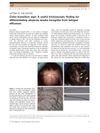
March 2018 in “The Journal of Dermatology” The "color-transition sign" helps tell apart alopecia areata incognita from telogen effluvium by looking at hair color changes.
 1 citations
,
April 2018 in “Our Dermatology Online”
1 citations
,
April 2018 in “Our Dermatology Online” Trichoscopy can detect early signs of steroid overuse on the scalp, suggesting a need for non-steroidal treatments.
 June 2026 in “International Journal of Ayurvedic Medicine (Hyderabad)”
 Combining trichoscopy with Ayurveda can improve hair loss diagnosis and treatment.
 June 2026 in “EXPERIMENTAL & CLINICAL MEDICINE GEORGIA”
 Trichoscopy is useful for assessing androgenetic alopecia severity but can't determine hair loss stage alone.

A high neutrophil-to-lymphocyte ratio may predict poor response to hair loss treatment.
Trichoscopy is a valuable tool for accurately diagnosing scalp conditions without invasive procedures.
May 2025 in “Apollo Medicine” Trichoscopy is a useful tool for diagnosing and assessing the severity of alopecia areata.
 May 2025 in “IP Indian Journal of Clinical and Experimental Dermatology”
 Trichoscopy is useful for early detection and monitoring of female pattern hair loss.
 September 2021 in “International Journal of Epidemiology”
 The study concluded that examining the scalp with a special magnifying device helps diagnose the cause of widespread hair loss in adult women.
 February 2022 in “Scientia Pharmaceutica”
 Different hair loss treatment ingredients work well with TrichoTech™ vehicles for 3 to 6 months, making them good for use in hair treatments.
1 citations
,
March 2021 in “Frontiers in Medicine” Female pattern hair loss shows similar characteristics in both genders and should be classified by hair loss patterns, not gender.