4-(Ethoxycarbophenyl) retinamide is much less toxic than other retinoids.
 June 2024 in “ChemBioChem”
 Replenishing free 18-MEA can help restore damaged hair surfaces.
 December 2021 in “Black sea journal of health science”
 Valproic acid can cause a rare allergic reaction leading to fluid around the lungs and heart, which is treatable by changing medication.
2 citations
,
August 2004 Early diagnosis and proper treatment improve outcomes for methylmalonic acidemia.
4 citations
,
December 2022 in “Evidence-based Complementary and Alternative Medicine” Phenolic compounds from Quercus acutissima leaves, especially casuarinin, may help treat acne.
1 citations
,
September 2001 in “PubMed” Acitretin treats severe skin conditions but requires careful monitoring due to serious side effects.
 47 citations
,
January 2017 in “RSC Advances”
47 citations
,
January 2017 in “RSC Advances” Keratin peptides can change hair shape gently without harsh chemicals.

Azelaic acid helps with skin pigmentation issues, but its full effects are not completely understood.
46 citations
,
April 1987 in “Brain Research” Hair-follicle nerves in cats' spinal cords can be inhibited by GABA-related connections.
 5 citations
,
January 2020 in “Wiadomości lekarskie (Warsaw Poland)”
5 citations
,
January 2020 in “Wiadomości lekarskie (Warsaw Poland)” Patients with both connective tissue disease and acid reflux are more likely to have certain symptoms and physical signs.
 1 citations
,
January 1994 in “The Journal of Dermatologic Surgery and Oncology”
1 citations
,
January 1994 in “The Journal of Dermatologic Surgery and Oncology” The success of a chemical peel depends on assessing the depth of peeling accurately to achieve safe and predictable results.

30% supramolecular salicylic acid is safe and effective for treating mild to moderate facial acne.
 29 citations
,
August 2005 in “Biopolymers”
29 citations
,
August 2005 in “Biopolymers” L-cysteine slows down the breaking of bonds in hair due to electrostatic interactions.
December 2015 in “PLOS ONE” 5 citations
,
May 2025 in “Chemical and Biological Technologies in Agriculture” Humic acids enhance plant growth by improving root development and photobiology.
 25 citations
,
July 2020 in “Journal of cosmetic dermatology”
25 citations
,
July 2020 in “Journal of cosmetic dermatology” Deoxycholic acid is effective for reducing chin fat but can cause side effects and serious complications, so careful patient evaluation is needed.
9 citations
,
January 2013 in “BioMed research international” The conclusion suggests a new acne treatment that controls bacteria by reducing water in the skin's pores using sugar-like substances.
September 2024 in “The Scientific Issues of Ternopil Volodymyr Hnatiuk National Pedagogical University Series pedagogy” High uric acid can cause health problems, but lifestyle changes can help manage it.
 February 2025 in “International Journal of Cosmetic Science”
 A new amino acid derivative, ATS, improves hair texture and moisture, making it easier to straighten curly hair.

Apple cider vinegar rinses for synthetic hair extensions lack scientific proof of reducing harmful chemicals.
January 2026 in “International Journal of Dermatology” The new tool helps measure the impact of alopecia areata on children's quality of life.
 January 2024 in “LA Referencia (Red Federada de Repositorios Institucionales de Publicaciones Científicas)”
 Carbon Quantum Dots can effectively detect cobalt ions and methylcobalamin in water.
 3 citations
,
April 2015 in “Cleveland Clinic Journal of Medicine”
3 citations
,
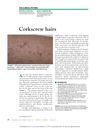
April 2015 in “Cleveland Clinic Journal of Medicine” The woman has scurvy and needs more vitamin C.
3 citations
,
January 1993 in “Toxicological Sciences” 2-Ethylhexanoic acid harms fertility and delays development in rats.
 January 2019 in “Advances in Environmental Biology”
 Propionibacterium acnes contributes to acne and antibiotic resistance, needing new treatments.
 May 2026 in “BMC Medicine”
 ACOD1 deficiency worsens hair loss by causing cell aging and mitochondrial problems, but 4-OI may help.
39 citations
,
May 2006 in “Molecular Plant-Microbe Interactions” Fusaric acid may help control Orobanche ramosa by activating plant defenses.
15 citations
,
August 1991 in “American Journal of Medical Genetics” A special diet can fix hair problems in argininosuccinase deficiency.
 October 2025 in “BMC Pediatrics”
 Timely zinc treatment is crucial for preventing severe complications in Acrodermatitis enteropathica.
 19 citations
,
May 2014 in “Molecules”
19 citations
,
May 2014 in “Molecules” Avicequinone C, a compound found in the Avicennia marina plant, can reduce hair loss by inhibiting a hormone linked to androgenic alopecia.