 9 citations
,
July 2016 in “The Journal of Dermatology”
9 citations
,
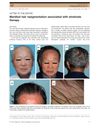
July 2016 in “The Journal of Dermatology” An 82-year-old man's white hair regained color after taking etretinate for psoriasis.
 January 2026 in “Figshare”
 Finasteride can cause melasma, especially in people with darker skin.
 August 2023 in “JAAD international”
 Most patients with Central Centrifugal Cicatricial Alopecia at the reviewed institution were middle-aged Black women, often with no symptoms, and commonly treated with topical medications.
 June 2026 in “Saudi Medical Horizons Journal”
 JAK inhibitors show promise in treating skin conditions like eczema, hair loss, and vitiligo but need more safety research.
2 citations
,
January 2024 in “Journal of the American Academy of Dermatology” Treating primary cicatricial alopecia is difficult and requires evidence-based methods.
2 citations
,
April 2025 in “Pediatric Dermatology” Macular alopecia is a distinct, non-scarring hair loss pattern that mostly affects young Hispanic/Latinx females and often resolves on its own.
1 citations
,
August 2019 in “Chinese Medical Journal” A man developed facial skin lesions after a stem cell transplant, which improved with specific treatments.
3 citations
,
March 2023 in “Cell Biology International” Stem cell-enriched fat grafts improve facial hyperpigmentation better than conventional grafts.
 21 citations
,
November 1981 in “Archives of Dermatology”
21 citations
,
November 1981 in “Archives of Dermatology” Ashy dermatosis may be linked to atopy and thyroid disease and can be treated with topical steroids.
1 citations
,
April 2016 in “Journal of the American Academy of Dermatology” Autoimmune conditions can be linked to trichoepitheliomas, with treatment focusing on cosmetic concerns.
April 2026 in “International Journal of Dermatology”  January 2022 in “Clinical dermatology open access journal”
 Early-stage Alopecia Areata was effectively treated in less than six months.
 February 2026 in “Frontiers in Immunology”
 Ivarmacitinib significantly improved hair regrowth in severe alopecia areata after tofacitinib was less effective.
1 citations
,
July 2025 in “Clinical and Experimental Dermatology” Deucravacitinib led to full hair regrowth in a severe alopecia areata patient.
September 1998 in “JEADV. Journal of the European Academy of Dermatology and Venereology/Journal of the European Academy of Dermatology and Venereology” Intermittent isotretinoin can cause various skin, hair, and nail changes.
5 citations
,
March 1943 in “Archives of Dermatology and Syphilology” A rare case of severe scalp hair loss and nail issues in keratosis follicularis was observed.
 March 2023 in “Photodiagnosis and Photodynamic Therapy”
 Low vitamin D levels are linked to severe and active alopecia areata.
 August 2010 in “The Journal of Dermatology”
 The document concludes that low-dose acne treatment is most suitable for moderate acne, with high patient satisfaction and low relapse rates.
 June 2023 in “JAAD case reports”
 The document concludes that "hot comb alopecia" is now called "central cicatricial centrifugal alopecia" and its causes are complex.
21 citations
,
October 2007 in “Australasian Journal of Dermatology” A woman with hair loss regrew white hair after taking prednisolone.
September 2019 in “Journal of Investigative Dermatology” Vitiligo patients are willing to pay the most for treatment, regardless of disease severity.
October 2025 in “Journal of the European Academy of Dermatology and Venereology” People often have negative attitudes towards facial skin conditions, with vitiligo seen most positively and psoriasis viewed most negatively.
 3 citations
,
February 2022 in “Cureus”
3 citations
,
February 2022 in “Cureus” Frontal fibrosing alopecia can sometimes look like syphilitic hair loss.
 11 citations
,
November 2018 in “Journal of the American Academy of Dermatology”
11 citations
,
November 2018 in “Journal of the American Academy of Dermatology” Tofacitinib therapy can effectively regrow eyebrows and eyelashes in some alopecia areata patients.
1 citations
,
October 2023 in “European Journal of Dermatology” Combining hair transplantation with PRP is more effective for treating hair loss than hair transplantation alone.
September 2016 in “European Journal of Pediatric Dermatology/PD. European journal of pediatric dermatology” Ulerythema ophryogenes causes hair thinning and inflammation, with limited treatment options.
 8 citations
,
November 2018 in “Australasian Journal of Dermatology”
8 citations
,
November 2018 in “Australasian Journal of Dermatology” Frontal fibrosing alopecia in families shows similar signs to individual cases and may have a genetic link.
 5 citations
,
March 2014 in “Journal of The American Academy of Dermatology”
5 citations
,
March 2014 in “Journal of The American Academy of Dermatology” The study suggests hormonal factors may play a role in Frontal Fibrosing Alopecia and that treatments like oral antiandrogens and steroids could be beneficial.