 2 citations
,
May 2018 in “Australasian Journal of Dermatology”
2 citations
,
May 2018 in “Australasian Journal of Dermatology” Some patients' hair grew back black and white after chemotherapy.
 1 citations
,
September 2022 in “JMIR dermatology”
1 citations
,
September 2022 in “JMIR dermatology” Alopecia Areata greatly affects the quality of life and mental health of Canadian patients and their caregivers.
 1 citations
,
February 2018 in “Australasian journal of dermatology”
1 citations
,
February 2018 in “Australasian journal of dermatology” Advanced imaging techniques are crucial for accurately diagnosing Monilethrix, a rare hair disorder.
 1 citations
,
January 2014 in “Health Renaissance”
1 citations
,
January 2014 in “Health Renaissance” Pseudopelade of Brocq is hard to diagnose and treat, with limited effective options.
 1 citations
,
February 2004
1 citations
,
February 2004 Skin diseases are common and can significantly affect people's lives; better outcome measures and ethical clinical trials are needed to improve dermatology care.
 1 citations
,
May 1999 in “Journal of Oral and Maxillofacial Surgery”
1 citations
,
May 1999 in “Journal of Oral and Maxillofacial Surgery” Patients with mandible reconstruction had better quality of life and function than those with soft-tissue reconstruction.
 April 2026 in “Nowotwory Journal of Oncology”
 Aesthetic treatments can safely improve cancer patients' quality of life with oncologist approval.
 April 2026 in “International Journal of Impotence Research”
 Anabolic steroid abuse can cause sexual, fertility, and health problems.
 March 2026 in “Current Research in Diabetes & Obesity Journal”
 Skin conditions can signal diabetes and insulin resistance.
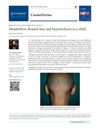 January 2026 in “Cosmoderma”
 A 9-year-old girl has a rare hair disorder causing beaded, sparse hair.
 January 2026 in “Nanoscale Advances”
 Microneedles combined with light therapy can improve skin disease diagnosis and treatment.
January 2026 in “Clinical Journal for Nurse Practitioners in Women s Health” Pregnancy can cause skin changes, some harmless and others risky, needing careful management.
 December 2025 in “IP Indian Journal of Clinical and Experimental Dermatology”
 Hair shaft disorders often indicate genetic or systemic issues and are managed by minimizing damage.
 December 2025 in “IP Indian Journal of Clinical and Experimental Dermatology”
 Androgenetic alopecia in males is linked to significant psychological distress, highlighting the need for both mental and dermatological care.
 June 2025 in “Saratov Medical Journal”
 Ongoing research and innovation are crucial for improving skin care and treatment.

Microneedling may improve neck scars, but more research is needed.
 April 2025 in “International Journal For Multidisciplinary Research”
 A rare ovarian tumor caused early puberty in a 3-year-old girl.
 January 2025 in “Journal of Case Reports and Scientific Images”
 Early diagnosis and treatment are crucial for managing Folliculotropic Mycosis Fungoides on the scalp.
 January 2025 in “Advances in Dermatology and Allergology”
 Eating foods with sulfhydryl may worsen pemphigus vulgaris.
 December 2024 in “Journal of Population Therapeutics and Clinical Pharmacology”
 Psoriasis worsens in winter in India due to less sunlight and dry skin, needing personalized treatment.
 September 2024 in “Cureus”
 A 10-year-old boy's nail condition is mainly cosmetic and improves over time with treatment.
 March 2024 in “Intisari Sains Medis”
 PRP injections improve periorbital wrinkles and show promise as a treatment.
 March 2024 in “International journal of life-sciences scientific research/SSR Institute of International Journal of Life Sciences”
 PCOS has many symptoms, with high androgen levels being the most common.
 February 2024 in “Journal of dermatology research reviews & reports”
 A 50-year-old woman with breast cancer developed an autoimmune skin disorder, highlighting the need for thorough checks and team-based treatment.
January 2024 in “Biomedicines” The review shows that skin symptoms like chronic fungal infections, hair loss, and skin depigmentation are key for early detection and management of APECED.

A neck lesion misdiagnosed as benign was later treated successfully with Mohs Micrographic Surgery.
 June 2023 in “GSC Advanced Research and Reviews”
 Hutchinson-Gilford Progeria Syndrome causes rapid aging from a genetic mutation, with no cure but ongoing research into potential treatments.

There is no cure for myotonic dystrophy type 1, so treatment focuses on managing symptoms and complications.

The guide suggests using keratin fibers and wigs to help hair look thicker or hide hair loss.
 August 2020 in “Nigerian journal of paediatrics”
 A 24-month-old Nigerian girl developed early puberty with no family history, needing treatment her family couldn't afford.