13 citations
,
January 2012 in “Dermatology” Eruptive vellus hair cysts are rare, benign skin lesions that are hard to treat.
 16 citations
,
April 2018 in “Animal Genetics”
16 citations
,
April 2018 in “Animal Genetics” Researchers found two genes that may explain why some Casertana pigs don't have hair.
21 citations
,
January 2009 in “Indian journal of dermatology, venereology, and leprology” A new method can better diagnose eruptive vellus hair cysts.
25 citations
,
January 2006 in “Journal of the European Academy of Dermatology and Venereology” A new technique effectively treats and diagnoses eruptive vellus hair cysts without recurrence.
December 2004 in “Reproduction Fertility and Development” Porcine hair follicles are useful for studying keratinocyte function, with galectin-1 as a potential stem cell marker.
 1 citations
,
January 2012 in “Journal of Toxicologic Pathology”
1 citations
,
January 2012 in “Journal of Toxicologic Pathology” A rat had a cyst similar to a hair follicle structure.
 January 1957 in “Nihon Chikusan Gakkaiho”
 Rabbit hair color is influenced by the shape and distribution of pigment granules.
 March 2022 in “Osaka City University (Osaka City University)”
 Ovariectomy in mice affects hair growth and skin thickness, suggesting potential for obesity treatment research.
5 citations
,
February 1981 in “Experientia” A new gene causes hairlessness and skin cysts in rats.
6 citations
,
August 2011 in “Anais Brasileiros de Dermatologia” Vellus hair cysts can cause acne-like bumps that don't respond to treatment.
November 2025 in “BMC Genomics” Wrinkled skin in Xiang pigs is linked to gene changes related to oxidative stress and the extracellular matrix.
 June 2025 in “Deleted Journal”
 Selamectin effectively cured the cats' infestation.
3 citations
,
June 2001 in “Journal of Zoo and Wildlife Medicine” The lemur's testicular tumor was removed, improving its coat and behavior, with no signs of cancer spread.
8 citations
,
August 1971 in “Canadian Journal of Zoology” Chinchillas have specific blood and protein levels, with variations possibly linked to pregnancy or hair growth.
8 citations
,
July 1986 in “International Journal of Dermatology” Eruptive vellus hair cysts are harmless skin bumps that may go away on their own.
 December 2025 in “International Journal For Multidisciplinary Research”
 Muridae species have unique hair patterns specific to each genus and species.
 March 2025 in “Buletin Veteriner Udayana”
 The cat's scabies and pneumonia improved significantly with treatment.
44 citations
,
November 2014 in “Tissue Engineering Part C Methods” Porcine skin varies by region, affecting its use as a human skin model.
 9 citations
,
July 2019 in “Folia Morphologica”
9 citations
,
July 2019 in “Folia Morphologica” Brandt's hedgehog has thick skin on its back and many glands near its nostrils.
21 citations
,
June 1992 in “Pediatric Dermatology” Eruptive vellus hair cysts are often underreported and need histologic confirmation for accurate diagnosis.
The curly mutation in SELH/Bc mice affects hair and may help study human genetic disorders.
1 citations
,
January 1992 in “DNA sequence” Researchers found a non-functional sheep keratin gene due to mutations.
5 citations
,
April 2019 in “Veterinary Dermatology” Cats infested with Lynxacarus radovskyi can lose hair without inflammation, treatable with selamectin.
29 citations
,
January 2003 in “Genomics” A new mouse mutation causes skin and hair issues, influenced by another gene.
13 citations
,
September 2012 in “Cell & tissue research/Cell and tissue research” pCLCA2 protein may help maintain skin structure and function.
1 citations
,
April 2024 in “Pathogens” A pet ferret had a serious infection from Mycobacterium xenopi, which can spread to humans.
7 citations
,
February 2017 in “Open veterinary journal” Tiger cubs fed artificial milk lacking certain amino acids developed eye problems and hair loss.
 August 2025 in “JURNAL PEMBELAJARAN DAN BIOLOGI NUKLEUS”
 Alopecia in bats is more common in urban areas due to habitat conditions.
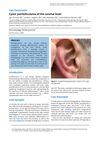 March 2026 in “Dermatology Online Journal”
 Cystic panfolliculoma is a rare, harmless tumor that can be confused with other skin tumors.
January 2005 in “Chinese Journal of Veterinary” Hairless mice lose hair by 3-4 weeks, develop thicker, folded skin, and show pigmentation differences.