 1 citations
,
July 2019 in “Microscopy Today”
1 citations
,
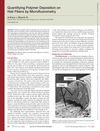
July 2019 in “Microscopy Today” Microfluorometry effectively measures how much polymer coats and penetrates hair, useful for evaluating hair products.
14 citations
,
February 2023 in “Frontiers in Bioengineering and Biotechnology” Hydrogel composites are promising for treating chronic diabetic ulcers due to their versatility and effectiveness.
 August 2024 in “Nature Communications”
 Softer hydrogels help wounds heal better with less scarring.
3 citations
,
October 2013 The new hydrogel and microemulsion could be better for hair loss treatment than current solutions.
 36 citations
,
August 2021 in “Nature Cell Biology”
36 citations
,
August 2021 in “Nature Cell Biology” Organoids can help study COVID-19 and develop treatments, but face challenges like instability and limited renewal.
14 citations
,
February 2024 in “Pharmaceutics” We need to study how dissolving microneedles behave in the body to use them for medicine.
Developing microRNA-based treatments is hard but has potential.
 January 2015 in “D-Scholarship@Pitt (University of Pittsburgh)”
 Diabetic patients' stem cells make vascular grafts more prone to clots, but new methods may improve grafts.

Researchers developed a cost-effective, ethical skin model using hairless guinea pig cells for toxicology studies.
29 citations
,
September 2020 in “Polymers” The PCL/PHB blend allows for slower, more controlled curcumin release than individual polymers.
7 citations
,
April 2020 in “Applied Sciences” Ultrasound helps create gels that speed up tissue formation.
 July 2023 in “Journal of Biomedical Science”
 Different people show different symptoms for genetic diseases because of how sensitive their bodies are to small changes in important factors.
March 2026 in “Materials Today Bio” The new cryo-MAP technique enables rapid and successful hair growth by transplanting hair follicle organoids.
9 citations
,
October 2020 in “bioRxiv (Cold Spring Harbor Laboratory)” Microglia are essential for zebrafish brain repair by controlling inflammation.
48 citations
,
February 2025 in “Advanced Materials” The hydrogel speeds up diabetic wound healing by adapting to glucose levels and releasing insulin.
 October 2025 in “Advanced Healthcare Materials”
 The hydrogels improve wound healing and tissue regeneration better than traditional treatments.
1 citations
,
January 2001 in “PubMed” Mechanoreceptors convert physical touch into electrical signals through specialized nerve structures.
26 citations
,
January 2024 in “Gels” Nanoemulgels could effectively treat skin diseases and may replace or complement current therapies.
June 2021 in “Zenodo (CERN European Organization for Nuclear Research)” Nanoemulsions can effectively improve the delivery of certain hydrophobic molecules.
1 citations
,
July 2025 in “Biomaterials Advances” 3D cultures respond better to minoxidil, while 2D cultures respond better to DHT.
Water and fatty acids affect hair's surface differently based on hair damage, and models can help understand hair-cosmetic interactions.
 51 citations
,
November 2013 in “Drug Discovery Today”
51 citations
,
November 2013 in “Drug Discovery Today” Small molecule drugs show promise for advancing regenerative medicine but still face development challenges.
July 2026 in “Materials Today Bio” DNA hydrogels can help repair tissues and treat tumors in regenerative medicine.
 28 citations
,
September 2020 in “Pharmaceutics”
28 citations
,
September 2020 in “Pharmaceutics” 3D-printed mesoporous scaffolds show promise for personalized drug delivery with controlled release.
10 citations
,
January 2025 in “Biomaterials Science” The hydrogel speeds up wound healing and is promising for treating complex wounds.
 35 citations
,
July 2009 in “Optics express”
35 citations
,
July 2009 in “Optics express” Researchers created a new light source that improves chemical imaging by removing background noise.
 4 citations
,
July 2022 in “Annals of translational medicine”
4 citations
,
July 2022 in “Annals of translational medicine” Scientists created complete hair-like structures by growing mouse skin cells together in a special gel.
9 citations
,
March 2022 in “Military Medical Research” Small molecules can help turn skin cells into sweat gland-like cells for potential skin repair.
 July 2026 in “Methods and Protocols”
 Diabetic mice have delayed wound healing with chronic wound characteristics.
December 2013 in “대한기계학회 춘추학술대회” A new cooling device keeps a constant temperature for medical procedures, improving results.