 2 citations
,
June 2019 in “Facial Plastic Surgery”
2 citations
,
June 2019 in “Facial Plastic Surgery” Medical tattooing improves appearance and quality of life, but has potential risks.
 January 2025 in “Open Medicine”
 High-concentration cell-free adipose extract reduces scar formation and improves scar appearance.
 December 2025 in “Journal of Education Health and Sport”
 LED therapy is safe and effective for improving skin health and appearance.
 September 2025 in “Journal of Cutaneous and Aesthetic Surgery”
 Scalp micropigmentation improves appearance and satisfaction in scarring alopecia but may require repeat sessions.
 June 2026 in “Journal of Cutaneous and Aesthetic Surgery”
 FUE is effective for improving hair regrowth and appearance in scarred areas.
 June 2024 in “Georgetown Scientific Research Journal”
 Bleomycin injections in mice cause skin thickening and hair loss.
 3 citations
,
February 2022 in “Cureus”
3 citations
,
February 2022 in “Cureus” Frontal fibrosing alopecia can sometimes look like syphilitic hair loss.
 70 citations
,
July 2016 in “Aging”
70 citations
,
July 2016 in “Aging” Targeting dermal adipocytes may help combat skin aging.
 39 citations
,
June 2019 in “Toxins”
39 citations
,
June 2019 in “Toxins” Bee venom might be a good alternative treatment for various skin conditions because it has many healing properties.
 July 2024 in “International Journal of Dermatology Venereology and Leprosy Sciences”
 The combination treatment improved acne scars.
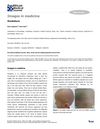 January 2013 in “The Pan African medical journal”
 Monilethrix causes short, fragile hair with no specific treatment available.
 130 citations
,
January 2017 in “International journal of nanomedicine”
130 citations
,
January 2017 in “International journal of nanomedicine” Silver nanoparticles coated with substances like PEG showed strong antibacterial effects and improved wound healing when used in hydrogels.
 61 citations
,
April 2014 in “Radiation Research”
61 citations
,
April 2014 in “Radiation Research” RTA 408 cream protects mice from radiation skin damage.
 60 citations
,
June 2019 in “Ageing Research Reviews”
60 citations
,
June 2019 in “Ageing Research Reviews” Fat from the body can help improve hair growth and scars when used in skin treatments.
 24 citations
,
January 2019 in “Biomaterials Science”
24 citations
,
January 2019 in “Biomaterials Science” The shape of fibrous scaffolds can improve how stem cells help heal skin.
 23 citations
,
July 2018 in “Journal of Cosmetic Dermatology”
23 citations
,
July 2018 in “Journal of Cosmetic Dermatology” Chemotherapy caused hair loss with specific patterns, but most patients had hair regrowth after treatment, while some had lasting hair loss.
 14 citations
,
September 2015 in “Ophthalmic plastic and reconstructive surgery”
14 citations
,
September 2015 in “Ophthalmic plastic and reconstructive surgery” Surgical removal of abnormal fat pads fixed the woman's eyelid issue caused by likely silicone injections.
 5 citations
,
February 2011 in “Aesthetic Plastic Surgery”
5 citations
,
February 2011 in “Aesthetic Plastic Surgery” The new technique for repositioning lower eyelid fat with a midface lift is easier, faster, and has better results with fewer complications.
 2 citations
,
October 1998 in “Dermatologic Surgery”
2 citations
,
October 1998 in “Dermatologic Surgery” Adjusting laser settings improved hair transplant results in Oriental patients.
 1 citations
,
January 2001 in “Dermatologic Surgery”
1 citations
,
January 2001 in “Dermatologic Surgery” Pulsed dye laser and hydrogel dressings effectively treat hypertrophic scars.
 June 2026 in “Frontiers in Immunology”
 EMT plays a key role in skin fibrosis and offers new therapy targets.

Adipocytes in atopic dermatitis skin change and worsen inflammation and fibrosis.
 October 2025 in “Clinical Cosmetic and Investigational Dermatology”
 Targeting specific cell interactions may help treat skin fibrosis.
 January 2017 in “Acta dermato-venereologica”
 The congress showed that psychological therapy can help skin condition patients, social media affects acne stigma, education improves atopic dermatitis, and patient satisfaction in dermatology is high, especially with good doctor engagement.
1 citations
,
January 2024 in “Fibrosis” Hydrogels show promise for scarless wound healing by reducing skin fibrosis.
 132 citations
,
June 2016 in “Cell and Tissue Research”
132 citations
,
June 2016 in “Cell and Tissue Research” The right cells and signals can potentially lead to scarless wound healing, with a mix of natural and external wound healing controllers possibly being the best way to achieve this.
71 citations
,
October 2017 in “Journal of Investigative Dermatology” PPAR-γ agonists like pioglitazone may help manage lichen planopilaris but don't fully reverse scarring.
36 citations
,
February 2016 in “British journal of pharmacology” Sirtuin 1 could be a potential drug target for treating hypertrophic scars.
Trichoepithelioma and desmoplastic trichoepithelioma have distinct features that can be identified using reflectance confocal microscopy.
6 citations
,
March 2024 in “Experimental Dermatology” Fibrosis causes loss of important fat cells, affecting tissue function.