 8 citations
,
January 1989 in “Annual Reports in Medicinal Chemistry”
8 citations
,
January 1989 in “Annual Reports in Medicinal Chemistry” Hair loss from alopecia areata and androgenetic alopecia can be treated, but more effective and safer treatments are needed.
 6 citations
,
January 2022 in “Journal of Investigative Dermatology”
6 citations
,
January 2022 in “Journal of Investigative Dermatology” Male pattern baldness is linked to higher levels of a certain receptor in the scalp, which leads to the shrinking of blood vessels and hair loss. Early treatment targeting this receptor could be more effective.
5 citations
,
January 2021 in “Frontiers in Cell and Developmental Biology” Inhibiting Zyxin may help treat androgenetic alopecia by promoting hair growth.
 5 citations
,
April 2016 in “The American Journal of Dermatopathology”
5 citations
,
April 2016 in “The American Journal of Dermatopathology” A tick bite caused temporary hair loss in a man, which is a rare condition that usually gets better within 3 months.
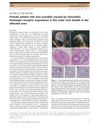 5 citations
,
August 2012 in “Journal of Dermatology”
5 citations
,
August 2012 in “Journal of Dermatology” Tamoxifen may cause female hair loss by increasing androgen receptor expression.
 3 citations
,
June 2023 in “The journal of investigative dermatology/Journal of investigative dermatology”
3 citations
,
June 2023 in “The journal of investigative dermatology/Journal of investigative dermatology” The conclusion suggests that focusing on certain cellular pathways may improve the prevention and repair of hair loss caused by radiotherapy.
 1 citations
,
January 2010 in “Springer eBooks”
1 citations
,
January 2010 in “Springer eBooks” Hair loss in androgenetic alopecia may be due to ongoing tiny inflammation and tissue changes around hair follicles.
 1 citations
,
August 2002 in “Zeitschrift für Hautkrankheiten”
1 citations
,
August 2002 in “Zeitschrift für Hautkrankheiten” Male androgenetic alopecia involves hair follicle miniaturization due to DHT, with potential treatments using inhibitors and blockers.
July 2026 in “Cell Transplantation” Fibroblasts in hair follicles play a key role in hair loss, suggesting they could be a target for treatment.
 June 2026 in “HAL (Le Centre pour la Communication Scientifique Directe)”
 SH-1 effectively treats hair loss without side effects.
 June 2026 in “Zenodo (CERN European Organization for Nuclear Research)”
 SH-1 effectively treats hair loss without side effects.
June 2026 in “Advanced Healthcare Materials” A new taurine-based liquid can help treat hair loss by improving hair follicle health and promoting regrowth.
 May 2026 in “Zenodo (CERN European Organization for Nuclear Research)”
 Androgenetic alopecia is common hair loss caused by genetics and hormones, with treatments mainly slowing it down.
 May 2026 in “Zenodo (CERN European Organization for Nuclear Research)”
 Alopecia treatments are improving, but future therapies need to target underlying causes for better results.
 May 2026 in “Zenodo (CERN European Organization for Nuclear Research)”
 Alopecia treatments are improving, but future therapies need to target underlying causes for better results.
 April 2026 in “Frontiers in Immunology”
 Blocking the CXCL12–CXCR4 axis may help treat hair loss in alopecia.
 March 2026 in “Lithuanian University of Health Sciences”
 Finasteride, dutasteride, and oral minoxidil are effective for treating hair loss, with spironolactone as an option for women.
 March 2026 in “Reports of Vinnytsia National Medical University”
 Alopecia areata in young Ukrainian men varies in severity, requiring personalized treatment.
 February 2026 in “Nature Communications”
 Inhibiting connective tissue sheath contraction may improve hair growth in male pattern baldness.
January 2026 in “Dermatologic Therapy” Female pattern hair loss can signal hormone issues and should be part of health checks for personalized treatment.
 December 2025 in “Russian Journal of Skin and Venereal Diseases”
 Mesenchymal stem cells show promise for hair regrowth in androgenetic alopecia, but more research is needed.
November 2025 in “Skin Appendage Disorders” Fibrosis contributes to hair loss in androgenetic alopecia, and targeting it may improve treatment.
November 2025 in “ACS Applied Materials & Interfaces” Plant-derived nanovesicles effectively deliver finasteride for hair regrowth in androgenetic alopecia.
November 2025 in “OPAL (Open@LaTrobe) (La Trobe University)” Plant-based nanovesicles effectively deliver finasteride for hair regrowth in androgenetic alopecia.
 November 2025 in “International Journal of Molecular Sciences”
 Combining different drugs can improve hair loss treatment.
 November 2025 in “Open Repository of the University of Porto (University of Porto)”
 Continuous use of finasteride and minoxidil is effective for treating androgenetic alopecia.
October 2025 in “JURNAL BIOLOGI TROPIS” Androgenetic alopecia is common hair loss due to genetics and hormones, manageable with early treatment.
September 2025 in “Journal of Natural Remedies” Herbal drugs show promise for treating alopecia with fewer side effects, but standardization is challenging.
 September 2025 in “bioRxiv (Cold Spring Harbor Laboratory)”
 Hair loss in males and females is influenced by immune cell interactions, with potential treatments identified.
 August 2025 in “Editora Pasteur eBooks”
 Combining conventional and integrative treatments can help reduce hair loss and improve hair growth in women with androgenic alopecia.