June 2026 in “Russian Journal of Skin and Venereal Diseases” Salmon-derived exosomes effectively improve hair growth in androgenetic alopecia.
 4 citations
,
September 2024 in “Oncology Research Featuring Preclinical and Clinical Cancer Therapeutics”
4 citations
,
September 2024 in “Oncology Research Featuring Preclinical and Clinical Cancer Therapeutics” 3D models and organoids improve liposarcoma research and therapy development.
 9 citations
,
December 2014 in “Neuropsychiatric Disease and Treatment”
9 citations
,
December 2014 in “Neuropsychiatric Disease and Treatment” People with first-time vitiligo have lower levels of a certain brain protein compared to healthy individuals.
10 citations
,
February 2022 in “Journal of cosmetic dermatology” Exosomes from fat-derived stem cells may help regrow hair.
 May 2026 in “Russian Journal of Skin and Venereal Diseases”
 Salmon tissue-derived exosomes improve hair growth better than platelet-rich plasma for treating hair loss.
 27 citations
,
April 2018 in “Scientific Reports”
27 citations
,
April 2018 in “Scientific Reports” Psoriasis patients' immune response to a hair protein depends on their specific gene type.
September 2024 in “Journal of the American Academy of Dermatology” Natural extracts like kombucha, marine enzymes, and prebiotics can improve and restore damaged skin.
 April 2024 in “The Indonesian Biomedical Journal”
 Melanocyte stem cells from non-affected skin in vitiligo patients can become functional melanocytes for potential therapy.
 November 2023 in “The journal of investigative dermatology/Journal of investigative dermatology”
 Adipose stem cell exosomes can effectively reduce facial redness and improve skin health in atopic dermatitis patients.
 11 citations
,
April 2013 in “Journal of Proteomics”
11 citations
,
April 2013 in “Journal of Proteomics” Found different proteins in balding and non-balding cells, giving insight into hair loss causes.
January 2019 in “Journal of Clinical Dermatology” The hair tonic improved hair growth and thickness without severe side effects.
4 citations
,
January 2013 in “Stem cell discovery” Researchers created a cell line from a hair follicle to study hair loss.
 October 2024 in “World Journal of Psychiatry”
 Stress worsens hair loss in androgenetic alopecia.
January 2025 in “TURKDERM” Alopecia areata patients experience more psychological distress, linked to certain neurotrophin levels.
 April 2026 in “International Journal of Molecular Sciences”
 Diabetic patients need tailored cosmetic treatments for skin aging, with new therapies showing promise.
55 citations
,
April 2015 in “BMC medicine” Stem Cell Educator therapy helps regrow hair and improve life quality in alopecia areata patients.
November 2025 in “Journal of Cosmetic Dermatology” Exosome therapy can safely and effectively restore color to gray hair.

Certain gene variations and different levels of BDNF and CRH hormones are linked to vitiligo.
 March 2026 in “Preprints.org”
 A diabetes-informed approach is essential for safe and effective skin rejuvenation treatments in diabetics.
 October 2024 in “Skin Research and Technology”
 Extracorporeal shock waves significantly improve hair growth in women with female pattern hair loss.

Exosome therapy successfully regrew and restored natural hair color in a man with stress-related hair loss.
 84 citations
,
June 2013 in “Stem Cells Translational Medicine”
84 citations
,
June 2013 in “Stem Cells Translational Medicine” New methods for skin and nerve regeneration can improve healing and feeling after burns.
17 citations
,
May 2025 in “MedComm” Organoid technology is improving personalized medicine by better predicting drug responses and treatments.
July 2024 in “Journal of Investigative Dermatology” Targeting TCR-Vβ2 in cutaneous T cell lymphoma shows promise for safer, more specific treatment.
 45 citations
,
May 2018 in “Stem Cell Research & Therapy”
45 citations
,
May 2018 in “Stem Cell Research & Therapy” Using patients' own fat-derived cells to treat alopecia areata significantly improved hair growth and was safe.
 March 2025 in “International Journal of Trichology”
 Injecting stem cells from a patient's own fat can improve hair growth in women with hair loss.
 April 2021 in “Journal of Cosmetic Dermatology”
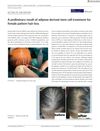
 Stem cell treatment improved hair density in female hair loss patient.
13 citations
,
December 2021 in “Journal of Cellular and Molecular Medicine” Exosome-enriched vesicles from placental cells improved skin condition in a patient with chronic graft-versus-host disease.
 May 2026 in “Clinical Cosmetic and Investigational Dermatology”
 The buffy coat method slightly outperformed apheresis in patient-reported hair improvement for treating hair loss.
 January 2025 in “Bioengineering”
 Combining PRS with TAFR is promising for treating complex fistulas, with most patients achieving long-term healing.