 August 2025 in “Macromolecular Bioscience”
 Microneedles with minoxidil and nitric oxide improve hair growth effectively and painlessly.
January 2025 in “SSRN Electronic Journal” The hydrogel speeds up wound healing by fighting infections and supporting tissue repair.
2 citations
,
July 2025 in “Chemical Engineering Journal” The hydrogel dressing effectively treats infected wounds by combining infection control and tissue regeneration.
25 citations
,
August 2024 in “Virtual and Physical Prototyping” 3D bioprinting could solve organ shortages and improve drug testing.
June 2026 in “Virtual and Physical Prototyping” A new method creates precise, stable microscale structures with reduced friction and potential for complex designs.
 101 citations
,
July 2021 in “Nature Communications”
101 citations
,
July 2021 in “Nature Communications” 4D polycarbonate scaffolds show promise for soft tissue repair due to their biocompatibility, shape memory, and minimal immune response.

PlacMA hydrogels from human placenta are versatile and useful for cell culture and tissue engineering.
 1 citations
,
July 2019 in “Microscopy Today”
1 citations
,
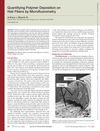
July 2019 in “Microscopy Today” Microfluorometry effectively measures how much polymer coats and penetrates hair, useful for evaluating hair products.
The method effectively creates uniform, viable cell spheroids for 3D cell culture.
June 2026 in “ACS Applied Polymer Materials” New polymer fibers can produce proteins and have potential uses in masks and swabs.
 26 citations
,
August 2016 in “ACS Applied Materials & Interfaces”
26 citations
,
August 2016 in “ACS Applied Materials & Interfaces” A boronic acid copolymer quickly forms cell clusters, useful for tissue and tumor modeling.
1 citations
,
August 1999 in “ACS symposium series” Polymer JR400 sticks to hair but washes off with detergent.
 421 citations
,
January 2015 in “Chemical Society Reviews”
421 citations
,
January 2015 in “Chemical Society Reviews” Improving artificial vascular grafts requires better materials and surface designs to reduce blood clotting and support blood vessel cell growth.
 119 citations
,
March 2020 in “Frontiers in Bioengineering and Biotechnology”
119 citations
,
March 2020 in “Frontiers in Bioengineering and Biotechnology” Asia has made significant progress in tissue engineering and regenerative medicine, but wider clinical use requires more development.
 61 citations
,
November 2020 in “Molecules”
61 citations
,
November 2020 in “Molecules” Conductive hydrogels show promise for medical uses like healing wounds and tissue regeneration but need improvements in safety and stability.
 41 citations
,
August 2024 in “Drug Delivery and Translational Research”
41 citations
,
August 2024 in “Drug Delivery and Translational Research” 3D-printed microneedles improve drug delivery by being precise, cost-effective, and less invasive.
 26 citations
,
March 2013 in “Journal of Biomedical Materials Research Part A”
26 citations
,
March 2013 in “Journal of Biomedical Materials Research Part A” Researchers created a 3D hydrogel that mimics human hair follicles, which may help with hair loss treatments.
 16 citations
,
August 2019 in “Cell Proliferation”
16 citations
,
August 2019 in “Cell Proliferation” Keratinocytes help keep hair follicle cells and skin cells separate in 3D cultures, which is important for hair growth research.
 12 citations
,
January 2018 in “Biomaterials Science”
12 citations
,
January 2018 in “Biomaterials Science” Softer hydrogel surfaces help maintain hair growth-related functions in skin cells.
 9 citations
,
April 2025 in “International Journal of Nanomedicine”
9 citations
,
April 2025 in “International Journal of Nanomedicine” An injectable ibuprofen gel speeds up diabetic wound healing by reducing inflammation and promoting tissue growth.
 5 citations
,
October 2025 in “International Journal of Nanomedicine”
5 citations
,
October 2025 in “International Journal of Nanomedicine” Traditional Chinese Medicine and biomaterials help heal chronic wounds by targeting multiple pathways.
 3 citations
,
January 2024 in “Materials advances”
3 citations
,
January 2024 in “Materials advances” Cellulose nanocrystals are promising for making effective, sustainable sensors for various uses.
 1 citations
,
January 2026 in “Frontiers in Cell and Developmental Biology”
1 citations
,
January 2026 in “Frontiers in Cell and Developmental Biology” AI improves biomaterial design by making it faster, cheaper, and more effective for personalized medicine.
 1 citations
,
January 2022 in “Pharmaceutical Sciences Asia”
1 citations
,
January 2022 in “Pharmaceutical Sciences Asia” Microneedles offer a painless, effective way to deliver drugs through the skin.
 May 2026 in “Iranian journal of pharmaceutical research”
 HAMA hydrogels speed up skin wound healing by reducing inflammation and boosting collagen production.
 March 2026 in “Tissue Engineering and Regenerative Medicine”
 Dopamine-modified adhesives are improving for sticking tissues underwater.
 February 2026 in “Bioimpacts”
 3D bioprinted hydrogels could improve diabetic wound healing but face challenges like limited blood supply and scalability.
 January 2026 in “Nano-Micro Letters”
 4D scaffolds made with melt electrowriting can change shape for use in medicine.
 January 2026 in “International Journal of Applied Pharmaceutics”
 Nanoparticle-embedded microneedles improve drug delivery through the skin but face challenges in stability and safety.
 November 2025 in “IECCMEXICO”
 3D bioprinting advancements are improving skin regeneration for wound healing and personalized reconstruction.